
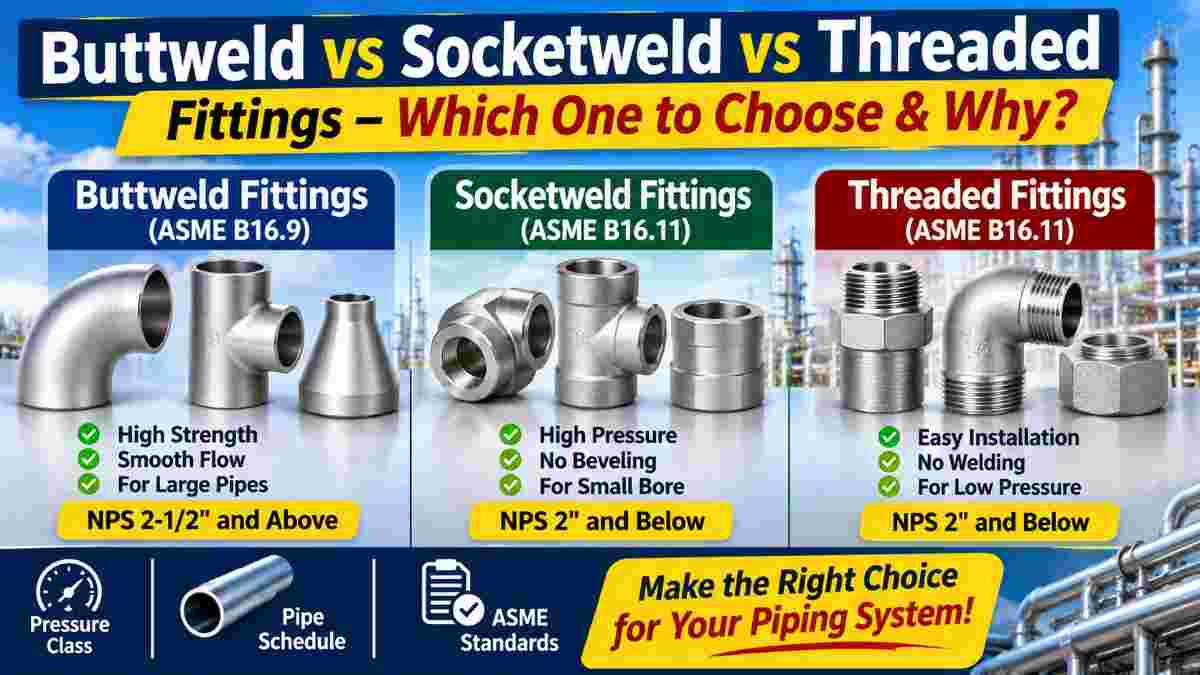
When designing or maintaining an industrial piping system, selecting the correct method to join pipes, valves, and fittings is just as critical as choosing the material itself. The three most common connection types—buttweld, socketweld, and threaded—each serve specific purposes based on pipe size, system pressure, fluid type, and maintenance requirements. Making the wrong choice can lead to leaks, premature failure, or excessive installation costs.
This guide compares these three fitting types, referencing ASME standards, to help you make an informed decision for your application.
Buttweld fittings provide permanent, full-penetration welded joints with smooth internal bores for high-pressure, larger-diameter pipelines, socketweld fittings use recessed sockets with external fillet welds for high-pressure small-bore lines (NPS 2" and under), and threaded forged fittings rely on tapered threads for fast, non-welded assembly in low-pressure utility and instrumentation systems.
Across industrial piping networks, the decision balances mechanical strength against ease of field installation. Shubham Metals supplies all three configurations across Stainless Steel, Duplex Steel, Super Duplex, Carbon Steel, Alloy Steel, and Nickel Alloys to match project piping specifications.
Engineers specify buttweld fittings (governed by ASME B16.9) as the standard choice for high-pressure, high-temperature, and larger-diameter pipelines (typically NPS 2-1/2" and above) because the full-penetration butt weld matches the structural strength of the pipe itself and maintains an uninterrupted internal diameter with minimal turbulence or pressure drop.
Superior Joint Strength: The welded connection withstands the same extreme pressures and temperatures as the main pipe wall under ASME B31.3 process piping codes.
Smooth Internal Flow: Aligning the fitting's inside diameter with the pipe bore eliminates internal pockets, reducing erosion, pressure drop, and flow turbulence.
Thermal & Vibration Fatigue Resistance: The continuous weld transition absorbs thermal expansion, contraction, and mechanical vibration far better than socket or threaded joints.
Permanent Leak-Tight Service: Ideal for hazardous, toxic, or volatile fluids where zero fugitive emissions are mandatory.
Browse our full catalog of elbows, tees, reducers, and caps on our Buttweld Fittings page.
Engineers choose socketweld or threaded forged fittings (governed by ASME B16.11) for small-bore piping of NPS 2" and smaller where butt welding becomes difficult to align, selecting socketweld fittings for high-pressure permanent joints without end beveling and threaded fittings where welding is prohibited or frequent disassembly is required.
Socketweld Fittings: The pipe end inserts into a recessed socket shoulder and is secured with an external fillet weld. They require no end beveling, align easily in tight spaces, and handle high pressures (Class 3000, 6000, and 9000), though the tiny internal expansion gap at the socket shoulder makes them unsuitable for severe crevice-corrosion services. Explore our SS Socket Weld Fittings range.
Threaded Forged Fittings: Tapered threads (such as NPT or BSP) create a mechanical seal using thread sealant or PTFE tape without hot work. While fast to assemble and disassemble in instrument air, water, and low-pressure utility lines (Class 2000 to 6000), thread roots thin the pipe wall and are vulnerable to vibration fatigue and thermal-cycling leaks. View our SS Threaded Fittings lineup.
Project piping specifications match fitting wall thickness to the connecting pipe schedule—using pipe schedules (Sch 10S through Sch XXS) for ASME B16.9 buttweld fittings and forged pressure classes (Class 2000, 3000, 6000, and 9000) for ASME B16.11 socketweld and threaded fittings based on design pressure and temperature.
Buttweld Connections (ASME B16.9): Available from NPS 1/2" up to 48" in schedules ranging from Sch 10S, Sch 40, and Sch 80 to Sch 160 and XXS for main process headers and high-temperature lines.
Socketweld Connections (ASME B16.11): Typically specified from NPS 1/8" to 2" in Class 3000, Class 6000, and Class 9000 for high-pressure steam, hydraulic, and chemical utility branches.
Threaded Connections (ASME B16.11): Typically specified from NPS 1/8" to 2" in Class 2000, Class 3000, and Class 6000 for non-hazardous, low-pressure water, air, and instrumentation connections.
Shubham Metals manufactures and stocks ASME B16.9 buttweld fittings and ASME B16.11 socketweld and threaded forged fittings in Bengaluru—supplying Stainless Steel (304/304L, 316/316L, 310S, 321, 904L), Duplex & Super Duplex, Inconel, Hastelloy, Monel, Carbon Steel, and Alloy Steel across India and global export markets.
Every fitting is supplied with full heat-number traceability, EN 10204 3.1 Mill Test Certificates (MTC), Positive Material Identification (PMI), and third-party inspection support (TUV, SGS, Lloyds, DNV) for both scheduled EPC projects and urgent plant shutdowns. Explore more piping and metallurgical guides on the Shubham Metals Blog, or call +91-97393-33696 / +91-80-41263159 to request a quote for your bill of materials today.