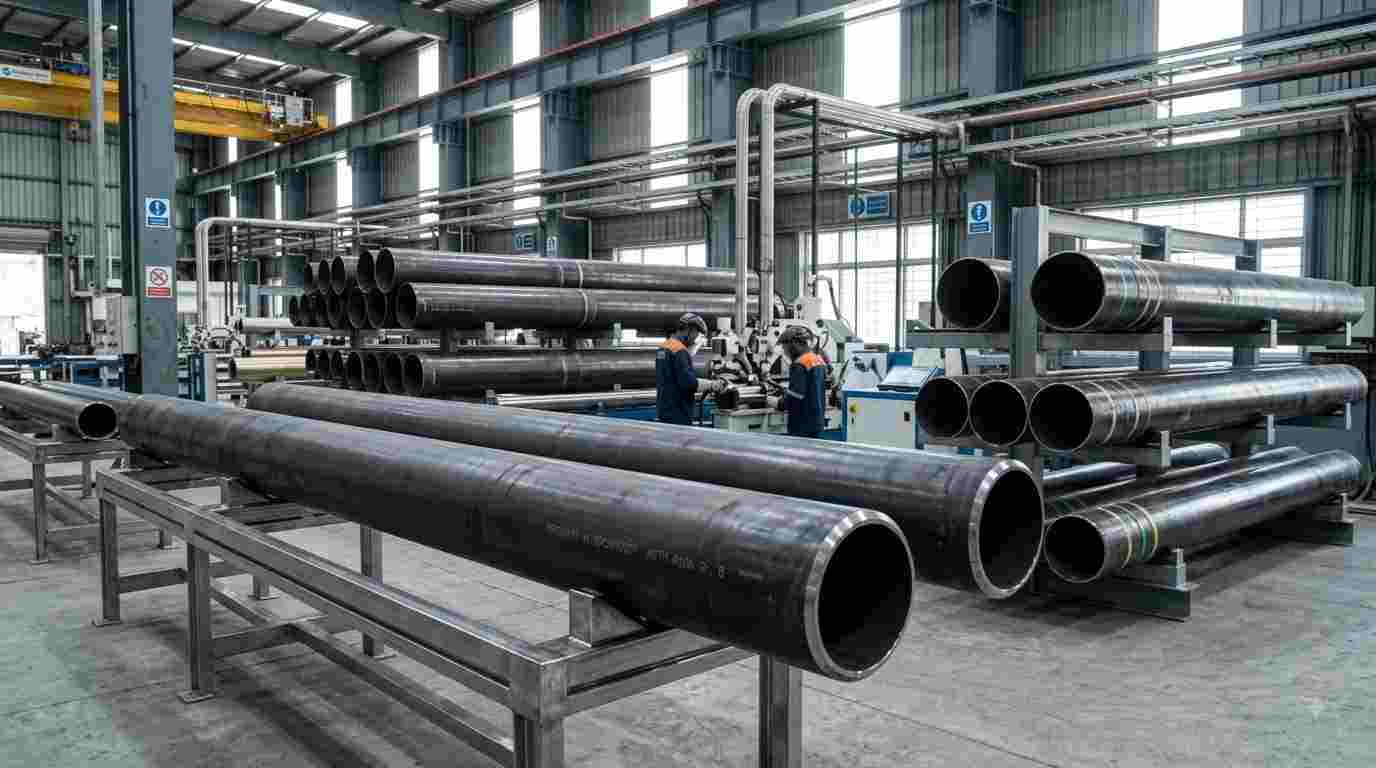
Carbon steel pipes serve as the foundational backbone of global industrial infrastructure. Deployed heavily across oil and gas transmission pipelines, power plant steam loops, municipal water mains, and heavy structural engineering, carbon steel provides an unbeatable combination of high tensile strength, excellent pressure containment, and cost-effective scalability.
Carbon steel pipes are classified according to their carbon content, manufacturing method (seamless vs. welded/ERW), and compliance with international engineering specifications:
ASTM A106 Grade B: The industry standard for seamless carbon steel pipe designed for high-temperature service in refineries, boiler plants, and petrochemical complexes.
ASTM A53 Grade B: A versatile specification covering seamless and welded (ERW) black and hot-dipped galvanized steel pipes suitable for pressure piping, structural frameworks, and general utility lines.
API 5L (Grades B through X70): Developed by the American Petroleum Institute specifically for conveying gas, water, and oil in the natural gas and petroleum industries over long distances.
ASTM A333 Grade 6: Engineered for low-temperature service applications where notch toughness is critical to prevent brittle fracture.
Choosing between seamless and welded carbon steel pipes depends directly on design pressure, operating temperature, and structural demands:
Seamless Carbon Steel Pipes: Manufactured by piercing a solid steel billet, seamless pipes possess no longitudinal weld seam. This uniform structure yields higher allowable design stresses and superior burst pressure resistance, making them ideal for high-pressure hydraulic and steam lines.
Welded & ERW Carbon Steel Pipes: Produced by roll-forming steel plates or coils and joining the edges via Electric Resistance Welding (ERW) or Submerged Arc Welding (SAW). Welded pipes offer tight dimensional tolerances, uniform wall thickness, and exceptional economy for large-diameter distribution networks.
To source compliant piping for demanding energy and utility projects, partnering with a certified stockist of ASTM A106 and A53 carbon steel pipe supplies ensures rigorous hydrostatic testing, non-destructive evaluation, and precise cut-to-length delivery.