
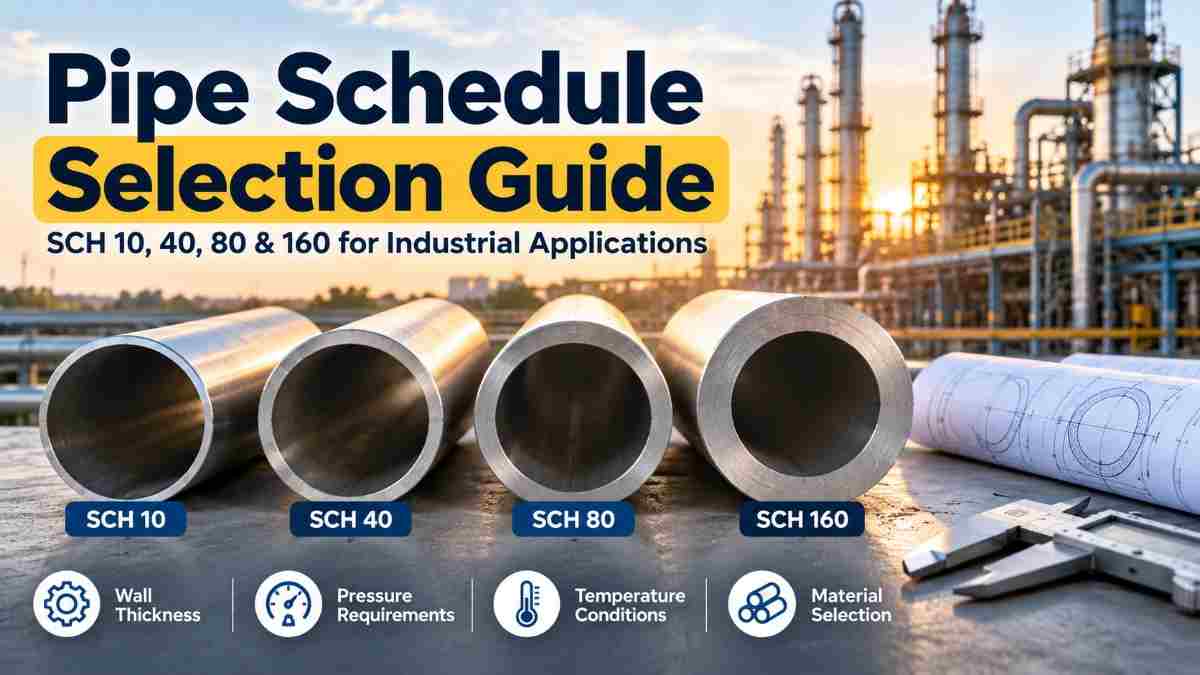
Are you selecting pipes for an industrial piping system but unsure whether Schedule 10, 40, 80, or 160 is the right choice? Pipe schedule is an important consideration when specifying piping for oil and gas facilities, chemical plants, power generation systems, water treatment facilities, and other industrial applications.
The right pipe schedule depends on the required wall thickness, design pressure, operating temperature, pipe material, corrosion allowance, and applicable engineering codes. Selecting a schedule based only on its number can lead to unnecessary costs, incorrect specifications, or unsuitable equipment.
Pipe schedules are standardized designations used to identify nominal wall thicknesses for specific pipe sizes. However, the same schedule number does not represent the same wall thickness across every nominal pipe size.
Shubham Metals supplies stainless steel pipes, alloy steel pipes, and other industrial piping materials for different applications.
This pipe schedule selection guide explains the differences between Schedule 10, 40, 80, and 160, how pipe dimensions work, and what industrial buyers should verify before purchasing.
A pipe schedule is a standardized designation that identifies the nominal wall thickness of a pipe for a particular nominal pipe size (NPS). Common designations include Schedule 10, Schedule 40, Schedule 80, and Schedule 160.
The schedule system helps engineers and purchasing teams specify pipe dimensions consistently.
For a given NPS, a higher schedule number generally represents a thicker pipe wall, although actual dimensions must always be checked against the relevant standard.
Pipe schedule affects:
Nominal wall thickness.
Approximate internal diameter.
Pipe weight.
Flow area.
Material consumption.
Pressure-design calculations.
Welding and fabrication requirements.
Procurement costs.
Pipe schedules are commonly referenced in industrial piping specifications alongside the material grade, dimensional standard, and manufacturing specification.
The primary difference between Schedule 10, 40, 80, and 160 pipes is their nominal wall thickness for a given pipe size. Schedule 10 is generally thinner than Schedule 40, while Schedule 80 and Schedule 160 represent progressively heavier wall designs where those schedules are defined.
Schedule 10 pipe is a relatively thin-wall option used in certain applications where engineering calculations and applicable standards permit its use.
Common considerations include:
Lower design-pressure requirements.
Reduced material weight.
Corrosion-resistant piping systems.
Specific stainless steel applications.
Cost and installation requirements.
Schedule 10 should not automatically be selected for every low-pressure system. Material strength, loading conditions, corrosion allowance, and applicable codes must be evaluated.
Schedule 40 is a commonly specified pipe schedule used in various industrial, commercial, and utility piping systems.
It provides a nominal wall thickness greater than Schedule 10 for many equivalent pipe sizes.
Potential applications include:
Industrial process piping.
Water distribution systems.
Utility lines.
Certain manufacturing facilities.
General-purpose piping installations.
Its suitability depends on the material, operating conditions, and relevant design calculations.
Schedule 80 pipe generally has a thicker wall than Schedule 40 pipe of the same NPS, making it an option when calculations require additional wall thickness.
It may be specified in:
Industrial process piping.
Certain high-pressure applications.
Chemical processing facilities.
Heavy-duty utility systems.
Piping where additional wall thickness is required.
However, Schedule 80 is not automatically suitable for all high-pressure or corrosive applications.
Schedule 160 is a heavy-wall pipe designation available for specified nominal pipe sizes under applicable dimensional standards.
It may be considered for demanding industrial systems where substantial wall thickness is required.
Potential applications include:
Specialized high-pressure piping.
Certain petrochemical systems.
Power generation facilities.
Heavy-duty industrial installations.
Engineered piping systems with demanding design requirements.
Actual pressure suitability must be calculated using the pipe material, temperature, dimensional tolerances, loading conditions, and applicable code.
Pipe schedule determines the nominal wall thickness associated with a specified NPS under the relevant dimensional standard. Increasing the schedule generally increases wall thickness while reducing the pipe's internal diameter.
For example, according to commonly published ASME B36.10M dimensions for NPS 4 pipe:
Schedule 40: Nominal wall thickness of 6.02 mm.
Schedule 80: Nominal wall thickness of 8.56 mm.
Both have a nominal outside diameter of 114.3 mm.
The thicker wall of Schedule 80 results in a smaller nominal inside diameter.
This example illustrates why buyers must specify both NPS and schedule when ordering industrial pipes.
Actual wall thicknesses are subject to the applicable manufacturing tolerances, and dimensions should be verified against the governing standard and purchase specification.
Nominal Pipe Size (NPS) identifies the standardized pipe size designation, while pipe schedule identifies its nominal wall thickness. Both are required to define the dimensions of most standard industrial pipes.
NPS does not always equal the actual outside diameter or inside diameter.
For example, an NPS 4 pipe has a standardized outside diameter of 4.500 inches, or 114.3 mm.
Its internal diameter changes depending on the wall thickness.
When ordering, buyers should specify:
Nominal pipe size.
Schedule designation.
Dimensional standard.
Material grade.
Manufacturing specification.
Required length.
End finish.
Quantity.
A complete specification helps prevent confusion between different pipe sizes and wall thicknesses.
The approximate nominal internal diameter of a pipe is calculated by subtracting twice the nominal wall thickness from the outside diameter.
The basic dimensional formula is:
Inside Diameter = Outside Diameter − (2 × Wall Thickness)
For example, consider an NPS 4 Schedule 40 pipe:
Outside diameter: 114.3 mm.
Nominal wall thickness: 6.02 mm.
The approximate nominal inside diameter is:
114.3 − (2 × 6.02) = 102.26 mm
This is a nominal dimensional calculation, not a guarantee of the exact measured bore.
Actual inside diameter may vary because of manufacturing tolerances, pipe construction, and other specification requirements.
Pipe schedule influences pressure capacity because wall thickness is one factor in pressure-design calculations. However, schedule alone cannot establish a pipe's allowable working pressure.
Pressure capacity depends on:
Material allowable stress.
Operating temperature.
Pipe outside diameter.
Effective wall thickness.
Manufacturing tolerances.
Corrosion allowance.
Joint and weld factors.
Applicable design code.
Other mechanical loads.
For example, two pipes with the same NPS and schedule but different material grades may have different allowable pressure limits.
Engineers should use the relevant piping design code, such as ASME B31.3 where applicable, to determine required pressure-design thickness.
Never substitute a generic schedule chart for a project-specific engineering calculation.
Operating temperature affects pipe schedule selection because material strength, thermal expansion, corrosion behavior, and allowable stress can change with temperature. A pipe suitable for one temperature range may not be appropriate for another.
For elevated-temperature systems, engineers should evaluate:
Material strength at operating temperature.
Applicable allowable stress values.
Thermal expansion.
Long-term material behavior.
Creep requirements, where relevant.
Corrosion and oxidation conditions.
External mechanical loading.
Applicable pressure-design calculations.
The material grade can be as important as wall thickness.
For projects requiring specialized material options, buyers can explore Alloy Steel Pipes from Shubham Metals.
ASME B36.10M is a dimensional standard for welded and seamless wrought steel pipe, while ASME B36.19M covers stainless steel pipe dimensions. Both provide standardized dimensional information, including outside diameters and nominal wall thicknesses.
ASME B36.10M provides dimensions for welded and seamless wrought steel pipe.
It includes commonly used schedule designations such as Schedule 10, 40, 80, and 160, subject to the size range and standard.
Engineers use these dimensions when specifying relevant steel piping systems.
ASME B36.19M covers dimensions for stainless steel pipe and includes schedule designations such as 5S, 10S, 40S, and 80S.
The letter S identifies schedule designations associated with the stainless steel pipe dimensional standard.
Buyers should not assume that similarly numbered schedules under different standards always have identical dimensions.
The applicable edition of the standard and the exact NPS must be checked.
Schedule 40 and Schedule 40S are dimensional designations associated with different pipe schedule standards. Schedule 40 commonly refers to ASME B36.10M, while Schedule 40S is defined under ASME B36.19M for stainless steel piping.
For many commonly used nominal sizes, their nominal wall thicknesses may coincide.
However, this does not mean the designations are interchangeable across all sizes or specifications.
When purchasing stainless steel pipe, confirm:
The applicable dimensional standard.
The exact NPS.
The specified schedule.
The nominal wall thickness.
The material specification.
Manufacturing tolerances.
Explore Stainless Steel Pipes from Shubham Metals for available product grades and specifications.
Corrosion allowance affects pipe schedule selection by adding material thickness intended to account for anticipated wall loss during the service life of a piping system. The required allowance depends on the fluid, material, environment, expected service conditions, and engineering assessment.
Not every piping system uses the same corrosion allowance.
For example, a process involving corrosive media may require additional attention to material compatibility and anticipated wall loss.
Engineers should consider:
Expected corrosion mechanisms.
General corrosion rates.
Localized corrosion risks.
Intended service life.
Operating temperature.
Process fluid composition.
Inspection and maintenance requirements.
Applicable design-code provisions.
Increasing wall thickness does not necessarily solve localized corrosion, stress-corrosion cracking, or material incompatibility.
In some cases, choosing a more suitable corrosion-resistant alloy may be more appropriate than specifying a thicker pipe made from an unsuitable material.
A thicker pipe wall may provide additional material allowance for certain wall-loss mechanisms, but it does not automatically make the pipe material more corrosion-resistant. Corrosion resistance depends primarily on material composition, environment, operating conditions, and corrosion mechanisms.
For example, stainless steel and alloy steel grades differ in their chemical composition and resistance to specific environments.
When corrosion is a major concern, evaluate:
Material grade.
Process fluid chemistry.
Chloride exposure.
Operating temperature.
General corrosion rates.
Localized corrosion mechanisms.
Fabrication and welding considerations.
Pipe wall thickness and material selection should be evaluated together.
Shubham Metals offers Stainless Steel Pipes and Alloy Steel Pipes for different industrial requirements.
Pipe schedule affects flow calculations because wall thickness changes the available internal diameter for a given nominal pipe size. A thicker wall generally reduces the flow area when the outside diameter remains constant.
For example, an NPS 4 Schedule 80 pipe has a smaller nominal internal diameter than an NPS 4 Schedule 40 pipe.
Under otherwise comparable conditions, a reduced internal flow area may increase fluid velocity and friction-related pressure losses for the same volumetric flow rate.
Engineers should evaluate:
Required flow rate.
Fluid density and viscosity.
Actual internal diameter.
Allowable fluid velocity.
Frictional pressure loss.
Pump or compressor requirements.
Erosion or noise concerns.
Pipe schedule should therefore be selected using both mechanical design and hydraulic performance considerations.
A higher pipe schedule generally increases material weight for the same nominal pipe size and material because the wall is thicker. This can influence product pricing, transportation, handling, fabrication, and installation costs.
Cost considerations include:
Material consumption.
Pipe length and diameter.
Material grade.
Manufacturing method.
Welding requirements.
Supporting structure loads.
Freight and handling.
Installation labor.
Long-term maintenance needs.
Thicker piping may also require additional fabrication effort and different welding procedures.
However, price differences depend on product availability, manufacturing specifications, market conditions, and order quantities.
The most cost-effective schedule is the one that satisfies the project's technical requirements without unnecessary overspecification.
Pipe schedule selection for oil and gas applications depends on the applicable design code, pressure, temperature, fluid characteristics, material specification, corrosion considerations, and mechanical loading.
Industrial oil and gas systems may involve demanding conditions, including variable operating pressures, corrosive fluids, and elevated or reduced temperatures.
A suitable selection process includes:
Identify the applicable engineering code.
Determine design pressure and temperature.
Select the required material grade.
Calculate pressure-design wall thickness.
Consider corrosion and mechanical allowances.
Account for manufacturing tolerances.
Select a standardized pipe schedule.
Verify hydraulic and mechanical requirements.
Confirm product specifications and testing documentation.
Additional industry or project requirements may apply.
The final schedule should be approved through the project's engineering design process.
Chemical processing facilities should select pipe schedules by evaluating process pressure, operating temperature, fluid compatibility, corrosion mechanisms, and the relevant piping design code.
Chemical plants may handle substances that affect metals differently.
For these projects, engineers should review:
Chemical compatibility.
Operating and upset conditions.
Corrosion allowance.
Process pressure.
Material temperature limits.
Welded-joint requirements.
Inspection requirements.
Maintenance and service life.
Material selection should not be based solely on wall thickness.
Depending on the process environment, corrosion-resistant stainless steel or other alloy systems may be required.
Choose between stainless steel and alloy steel pipes based on the required mechanical properties, corrosion resistance, operating temperature, fabrication requirements, and applicable material specification.
Stainless steels include grades selected for different corrosion-resistance and temperature requirements.
Alloy steels include materials engineered for particular mechanical and high-temperature performance requirements.
Before choosing, evaluate:
Design temperature and pressure.
Exposure to corrosive substances.
Required mechanical strength.
Weldability.
Material specifications.
Applicable heat-treatment requirements.
Service environment.
Total procurement and maintenance costs.
Buyers can review the Stainless Steel Pipe Collection and Alloy Steel Pipe Collection at Shubham Metals.
Before ordering industrial pipes by schedule, buyers should verify NPS, wall thickness, material grade, dimensional standard, manufacturing specification, inspection requirements, quantity, and delivery conditions.
A complete purchasing checklist includes:
Nominal Pipe Size: Specify the required NPS or DN.
Schedule: Identify Schedule 10, 40, 80, 160, or another applicable designation.
Dimensions: Confirm outside diameter and nominal wall thickness.
Material: Specify the required grade.
Manufacturing specification: Identify the applicable ASTM, ASME, or other standard.
Manufacturing method: Confirm seamless or welded construction where required.
Length: Specify random or fixed lengths as applicable.
End finish: Identify plain, beveled, or other required ends.
Inspection: Define applicable dimensional and testing requirements.
Documentation: Request required material certificates and traceability records.
Quantity: Specify the number of pieces or required total length.
Delivery: Confirm packaging, destination, and schedule.
Clear technical specifications help suppliers prepare more accurate quotations.
Common pipe schedule selection mistakes include assuming higher schedules are always better, confusing NPS with actual dimensions, ignoring material strength, and selecting wall thickness without reviewing operating conditions.
Avoid these errors:
Selecting pipe schedules based only on pressure assumptions.
Assuming the same schedule means identical wall thickness across all pipe sizes.
Confusing Schedule 40 with Schedule 40S.
Ignoring manufacturing tolerances.
Overlooking corrosion allowance.
Using nominal wall thickness directly without code-required adjustments.
Failing to check temperature-dependent allowable stress.
Ignoring flow requirements.
Purchasing the wrong material grade.
Omitting the governing standard from purchase documents.
The correct schedule should be based on engineering requirements and standardized dimensional data.
Shubham Metals supplies stainless steel pipes, alloy steel pipes, and other metal products for industrial applications. Its product portfolio includes different material grades used in engineering and manufacturing industries.
The company is based in Bangalore, India, and provides products for customers requiring industrial metal materials.
Its available product categories include:
Stainless steel pipes.
Alloy steel pipes.
Carbon steel pipes.
Nickel alloy pipes.
Duplex steel pipes.
Other specialty metal products.
Buyers can explore the Stainless Steel Pipe Product Range and Alloy Steel Pipe Product Range to identify suitable product categories.
Available sizes, schedules, quantities, certifications, and delivery arrangements should be confirmed for each enquiry.
Common pipe schedule questions concern wall thickness, pressure capacity, dimensional standards, and the differences between Schedule 10, 40, 80, and 160. The following answers address these technical purchasing considerations.
For the same pipe size and material, Schedule 80 generally has a thicker nominal wall than Schedule 40, which can influence pressure capacity and mechanical performance. Actual suitability must be determined through engineering calculations.
Schedule 40 may be suitable for some pressurized systems, but its allowable pressure depends on the pipe size, material grade, temperature, wall thickness, and applicable design code.
Schedule 10 generally has a thinner wall than Schedule 40 for the same nominal pipe size, where both schedules are defined. The actual dimensions must be checked against the governing standard.
Not necessarily. Schedule 160 is a heavy-wall designation, but other wall-thickness designations and specially manufactured pipe dimensions may be available.
For a given standardized NPS, selecting a different schedule generally does not change the nominal outside diameter. It changes the nominal wall thickness and internal diameter.
SCH is an abbreviation for schedule. It identifies the nominal wall-thickness designation associated with a specified pipe size and dimensional standard.
No. Pipe schedule is a dimensional designation, while pressure rating or allowable design pressure depends on material properties, temperature, geometry, code requirements, and other factors.
NPS is the nominal pipe size designation commonly used in inch-based systems, while DN is a corresponding metric nominal designation. Neither should automatically be interpreted as the exact measured internal or external diameter.
Yes. Stainless steel pipe products are available in various schedule designations, including 40S and 80S under ASME B36.19M, subject to size, material specification, and supplier availability.
No. Service life also depends on corrosion mechanisms, temperature, pressure, cyclic loading, material quality, installation, and maintenance. Increasing wall thickness does not address every failure mechanism.
You can request stainless steel or alloy steel pipes from Shubham Metals by providing the required material grade, NPS, schedule, manufacturing specification, quantity, and delivery requirements.
For an accurate enquiry, include:
Required pipe material.
Nominal pipe size.
Pipe schedule or specified wall thickness.
Applicable dimensional standard.
ASTM, ASME, or other material specification.
Manufacturing method.
Required length and end finish.
Testing and certification requirements.
Order quantity.
Delivery destination.
Supplying complete specifications helps reduce purchasing errors and supports clearer communication between engineering teams and suppliers.
Looking for an industrial pipe supplier in India?
Explore Stainless Steel Pipes from Shubham Metals or Alloy Steel Pipes from Shubham Metals to review available products and discuss your requirements.
Technical Note: Pipe schedule selection is an engineering design decision. The information in this guide is intended for general technical understanding and procurement planning. Final wall thickness, pressure suitability, and material selection must be verified by qualified professionals under the applicable codes and project specifications.