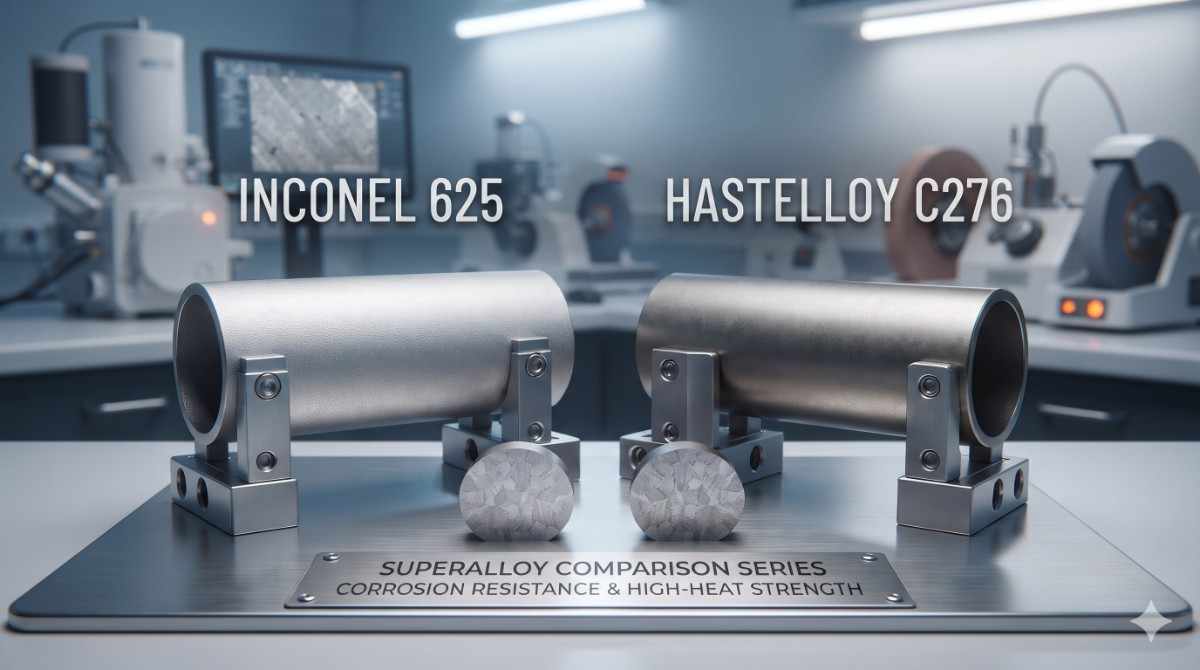
Selecting between Inconel 625 and Hastelloy C276 is a critical engineering decision when specifying pipes, tubes, and fittings for aggressive chemical reactors, offshore platforms, flue-gas desulfurization units, and high-temperature exhaust systems. Both are nickel-chromium-molybdenum superalloys engineered to resist pitting, crevice corrosion, and chloride stress-corrosion cracking where standard stainless steels fail. However, differences in their niobium, tungsten, and molybdenum balances give each grade distinct advantages in high-heat mechanical strength versus severe reducing-acid resistance.
Inconel 625 (UNS N06625) uses niobium additions to deliver superior high-temperature tensile, creep, and fatigue strength from cryogenic levels up to 982°C, whereas Hastelloy C276 (UNS N10276) uses higher molybdenum and tungsten content with ultra-low carbon to resist severe reducing acids, wet chlorine gas, and localized pitting in complex chemical media.
Across industrial piping systems, Inconel 625 acts as a high-strength, solid-solution-hardened structural and marine superalloy, while Hastelloy C276 serves as the benchmark chemical-process alloy for mixed oxidizing and reducing environments where weld-zone corrosion resistance is vital.
Engineers should specify Inconel 625 when piping systems face extreme mechanical stress, thermal cycling, seawater exposure, or elevated temperatures—such as subsea oil and gas risers, FPSO topsides, aerospace exhaust ducts, heat exchangers, and high-pressure sour-gas lines.
Because solid-solution strengthening from molybdenum and niobium eliminates the need for post-weld heat treatment to achieve high yield strength, an Inconel 625 Pipe maintains structural stability under both static pressure and cyclic vibration. Pairing seamless or welded pipes with matching Inconel 625 Buttweld Fittings prevents galvanic corrosion and preserves smooth internal flow across critical process loops.
Hastelloy C276 is preferred in hydrochloric acid, sulfuric acid, wet chlorine, ferric and cupric chlorides, and pharmaceutical synthesis reactors because its ~16% molybdenum and ~4% tungsten chemistry resists both oxidizing and reducing corrosive agents, while its ultra-low carbon and silicon levels prevent grain-boundary carbide precipitation during welding.
Where elevated temperatures or mixed acid streams quickly attack standard austenitic alloys, specifying a Hastelloy C276 Pipe (ASTM B622 seamless or ASTM B619 welded) in the solution-annealed condition ensures reliable as-welded corrosion resistance. For small-bore instrumentation, sampling, and high-pressure chemical injection lines, matching Hastelloy C276 Threaded Fittings maintain uniform alloy integrity throughout every joint.
Inconel 625 is governed by ASTM B444 (seamless pipe and tube) and ASTM B366 (fittings) with ~58% min nickel, 20–23% chromium, 8–10% molybdenum, and 3.15–4.15% niobium, whereas Hastelloy C276 follows ASTM B622 / B619 and ASTM B366 with ~57% balance nickel, 14.5–16.5% chromium, 15–17% molybdenum, and 3–4.5% tungsten.
| Specification Parameter | Inconel 625 (UNS N06625) | Hastelloy C276 (UNS N10276) |
|---|---|---|
| Primary Alloying Balance | Ni-Cr-Mo with Niobium (3.15–4.15%) | Ni-Mo-Cr with Tungsten (3.0–4.5%) |
| Core Strength | High tensile, creep & fatigue strength at elevated heat | Exceptional resistance to reducing & oxidizing acids |
| Seamless Pipe Standard | ASTM B444 / ASME SB444 | ASTM B622 / ASME SB622 |
| Buttweld Fitting Standard | ASTM B366 / ASME SB366 | ASTM B366 / ASME SB366 |
| Typical Service Focus | Marine, subsea oil & gas, aerospace, high-temp heat | Chemical reactors, FGD scrubbers, chlorides, wet chlorine |
Both alloys offer good weldability using matching filler metals (ERNiCrMo-3 for Inconel 625 and ERNiCrMo-4 for Hastelloy C276), with Hastelloy C276 specifically engineered to remain in service in the as-welded condition without sensitizing the heat-affected zone.
Before issuing a purchase order for Inconel 625 or Hastelloy C276 pipes and fittings, procurement teams should confirm UNS grade, ASTM/ASME specification, seamless versus welded construction, outer diameter and wall schedule (Sch 10 to Sch XXS), end preparation (plain or beveled), solution-annealed heat treatment, and EN 10204 3.1 or 3.2 Mill Test Certificates (MTC).
Requiring Positive Material Identification (PMI), hydrostatic testing, eddy-current or ultrasonic non-destructive testing (NDT), and NACE MR0175 / ISO 15156 compliance verification ensures full heat-number traceability before dispatch to critical refinery or chemical sites.
Shubham Metals supplies ASTM/ASME-certified Inconel 625 and Hastelloy C276 seamless and welded pipes, heat-exchanger tubes, buttweld fittings, forged threaded and socketweld fittings, and flanges from our Bangalore warehouse for urgent shutdowns and scheduled EPC projects across India and global export markets.
Every batch undergoes strict dimensional checks, PMI verification, and hydro/NDT inspection backed by complete EN 10204 3.1 MTCs and third-party inspection support (TUV, SGS, Lloyds, and DNV). Explore more alloy and piping comparisons on the Shubham Metals Blog or learn more about our quality standards on our About Us page. Have an active bill of materials for nickel alloy pipes or fittings? Call +91-97393-33696 or +91-80-41263159 for technical grade guidance and an immediate quote today.