
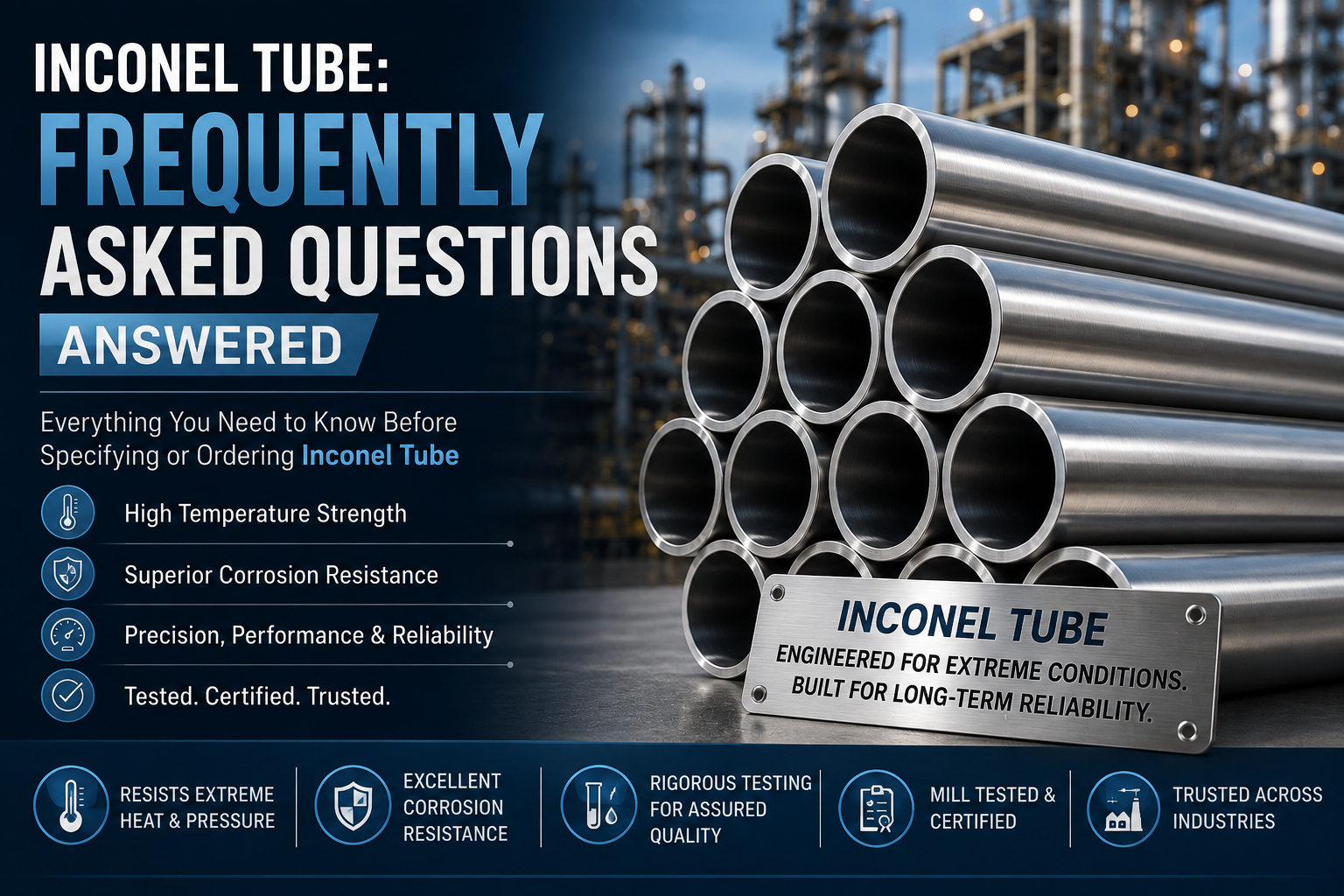
Heat exchangers, marine systems, and chemical processing lines all place unusual demands on tubing. This FAQ-style guide answers the questions buyers most commonly ask about Inconel Tube before specifying or ordering material for a project.
It is produced from nickel-based superalloys engineered specifically for high-temperature and corrosion-resistant service. This composition allows it to hold its mechanical properties and dimensional accuracy in environments where standard alloy tubing would degrade, crack, or lose strength over time.
Different grades resist different combinations of heat, pressure, and chemical attack, so the wrong grade can lead to early failure even if the tube looks identical on paper. Matching grade to actual operating conditions — not just budget — is the single biggest factor in getting long-term reliability out of a tubing system.
Production is generally carried out against ASTM A213, A269, A789, B338, B622, and B163, often alongside ASME and EN 10216 requirements. These specifications define acceptable chemistry, dimensional tolerance, and testing protocols, and compliance is usually confirmed through an EN 10204 3.1 or 3.2 mill test certificate before dispatch.
Outer diameters commonly range from 1/8" up to 24" (roughly 3 mm to 600 mm), with wall thicknesses between 0.5 mm and 20 mm. Because tube walls are thinner than pipe walls, precise sizing has an even bigger impact on heat transfer efficiency and pressure handling, so specifying the correct dimensions early avoids costly rework later.
Both construction types are available, including seamless, welded, ERW, and EFW forms. Seamless tubing is generally preferred for the most demanding pressure and temperature conditions, while welded tubing can be a practical, cost-effective option for less severe applications when produced under tightly controlled conditions.
Typical finish options include bright annealed, pickled, polished, and mirror finishes. The choice usually depends on the application — heat exchanger tubing often calls for a smooth, bright-annealed interior surface to support efficient thermal transfer, while structural or general processing tubing may only need a standard pickled finish.
Standard checks include hydrostatic testing, eddy current testing, U-bend testing, flare testing, flattening testing, and intergranular corrosion (IGC) testing. Together, these tests confirm that the tube can handle bending, pressure cycling, and corrosive exposure without developing cracks or weak points once it's in service.
Plain end, bevelled end, and square-cut end are the standard options. The right end type depends on how the tube will be connected within the system — whether by welding into a header, fitting into a tube sheet, or joining through a mechanical connection — and should be confirmed with the fabricator before ordering.
Common applications include chemical processing for corrosive and high-pressure environments, marine and offshore systems exposed to seawater, aerospace components subject to high heat and stress, heat exchangers and condensers requiring efficient thermal transfer, and petrochemical plants operating under sustained high pressure and temperature.
Tube and pipe are dimensioned differently — tube is generally specified by exact outer diameter and wall thickness, while pipe follows nominal size and schedule conventions. Tube is also more commonly used in heat-transfer applications like exchangers and condensers, where tighter tolerances and thinner walls improve thermal efficiency, whereas pipe is more often used for general fluid transport.
Tubing is typically supplied as single random, double random, cut-to-size, or coil length, depending on the manufacturing process and project requirements. Custom cutting is usually available for projects with specific length constraints, reducing on-site waste and installation time.
Start by identifying the operating temperature, pressure, and chemical exposure your system will face, then narrow down grade, wall thickness, and finish based on those conditions. Confirm the applicable standard, request mill test documentation, and clarify lead times with your supplier before finalizing the order to avoid compliance or scheduling surprises later.
Choosing the right nickel-based superalloy tubing comes down to matching grade, dimensions, and finish to the exact demands of your system. Whether the project involves heat exchangers, marine equipment, chemical processing, or aerospace components, working through these questions early helps prevent premature failure and keeps operations running smoothly over the long term.
Reach out to a technical team with your grade, dimension, and application details for guidance on specification, testing, and delivery timelines.