
Selecting the right pipe is a critical decision for industries that rely on efficient fluid transportation, structural integrity, and long-term operational reliability. Whether used in oil and gas, construction, power generation, petrochemicals, manufacturing, or water treatment systems, pipes play a vital role in ensuring safe and efficient operations.
Among the most commonly used options are seamless pipes and welded pipes. Both have distinct manufacturing processes, advantages, and applications. However, a common question among engineers, project managers, and procurement professionals is: Which option delivers better performance?
The answer depends on several factors, including operating pressure, temperature, budget, application requirements, and industry standards.At Shubham Metals Pvt. Ltd., we help industries select the most suitable piping solutions for their specific requirements. This guide explores the differences between seamless and welded pipes, their strengths, limitations, and performance characteristics to help you make an informed decision.
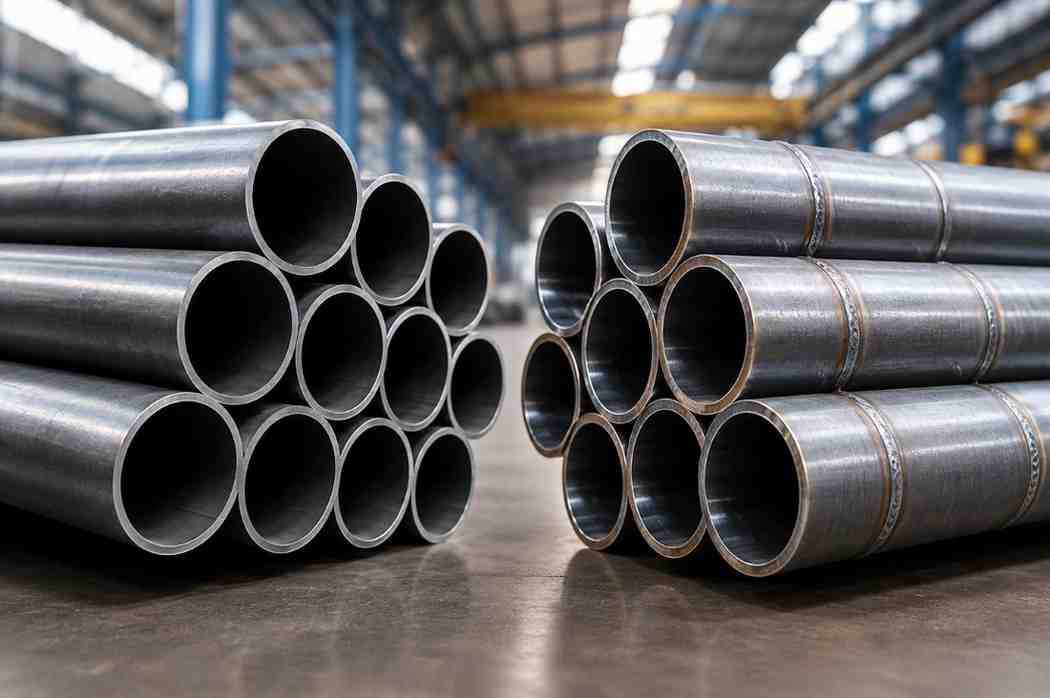
Seamless pipes are manufactured from a solid steel billet that is heated and pierced to create a hollow tube. Since no welding is involved during production, the pipe structure remains continuous throughout its length.
This manufacturing process results in a pipe with uniform strength and no welded joints.
Welded pipes are produced by rolling steel plates or coils into a cylindrical shape and joining the edges through a welding process.
Modern manufacturing technologies have significantly improved weld quality, making welded pipes suitable for a wide range of industrial applications.
When evaluating strength, seamless pipes often have an advantage because they do not contain a welded joint.
Since the pipe body is formed from a single piece of metal, there is no seam that could potentially become a weak point under extreme operating conditions.
Performance Winner: Seamless Pipe
High-pressure systems require piping solutions that can withstand significant internal stress.
Seamless pipes are generally preferred for:
Their uniform structure provides greater confidence in demanding environments.
Performance Winner: Seamless Pipe
Applications involving elevated temperatures require materials that maintain their strength and stability under thermal stress.
Seamless pipes perform exceptionally well in high-temperature environments due to their continuous metal structure.
Performance Winner: Seamless Pipe
Advancements in manufacturing technology have enabled welded pipes to achieve highly consistent dimensions and wall thickness.
For projects requiring precise specifications and uniformity, welded pipes often offer excellent dimensional control.
Performance Winner: Welded Pipe
Budget considerations play a significant role in industrial procurement decisions.
Welded pipes are generally more economical because their production process is less complex and more efficient than seamless pipe manufacturing.
For many applications, welded pipes provide excellent performance while reducing overall project costs.
Performance Winner: Welded Pipe
Large-diameter piping is commonly required in infrastructure, water transmission, and industrial systems.
Welded pipes are typically available in larger sizes and can be produced more efficiently for large-scale projects.
Performance Winner: Welded Pipe
Corrosion resistance depends primarily on the material grade rather than the manufacturing method.
Both seamless and welded pipes can offer outstanding corrosion resistance when manufactured from appropriate materials such as:
Performance Result: Tie
Industries that prioritize safety and operational continuity often prefer seamless pipes for critical systems.
Applications include:
The absence of a welded seam provides an additional level of confidence in challenging operating conditions.
Performance Winner: Seamless Pipe
Seamless pipes provide excellent durability under demanding operating conditions.
Ideal for applications involving high-pressure fluid transportation.
Suitable for high temperatures, aggressive chemicals, and critical industrial processes.
The absence of a welded joint eliminates potential seam-related concerns.
Lower production costs make welded pipes attractive for budget-conscious projects.
Well-suited for infrastructure and large-diameter piping systems.
Modern welding technologies ensure reliable and precise products.
Welded pipes can often be manufactured and supplied more quickly.
The choice between seamless and welded pipes depends on your project's operational requirements.
At Shubham Metals Pvt. Ltd., we supply premium-quality seamless and welded pipes that meet the highest industry standards.
Our commitment to quality, reliability, and customer satisfaction enables us to support diverse industries with piping solutions tailored to their specific operational needs.
Customers choose us because of:
Whether your project requires high-performance seamless pipes or cost-effective welded pipes, our team helps you select the ideal solution for long-term success.
When comparing seamless vs welded pipe performance, there is no one-size-fits-all answer. Seamless pipes offer superior strength, pressure resistance, and reliability for demanding applications, while welded pipes provide cost-effective, versatile, and dimensionally consistent solutions for a wide range of industrial projects.
The best choice depends on your operating environment, budget, safety requirements, and performance expectations.
By partnering with Shubham Metals Pvt. Ltd., businesses gain access to high-quality piping solutions, expert guidance, and dependable products designed to meet today's industrial challenges and tomorrow's growth opportunities.