
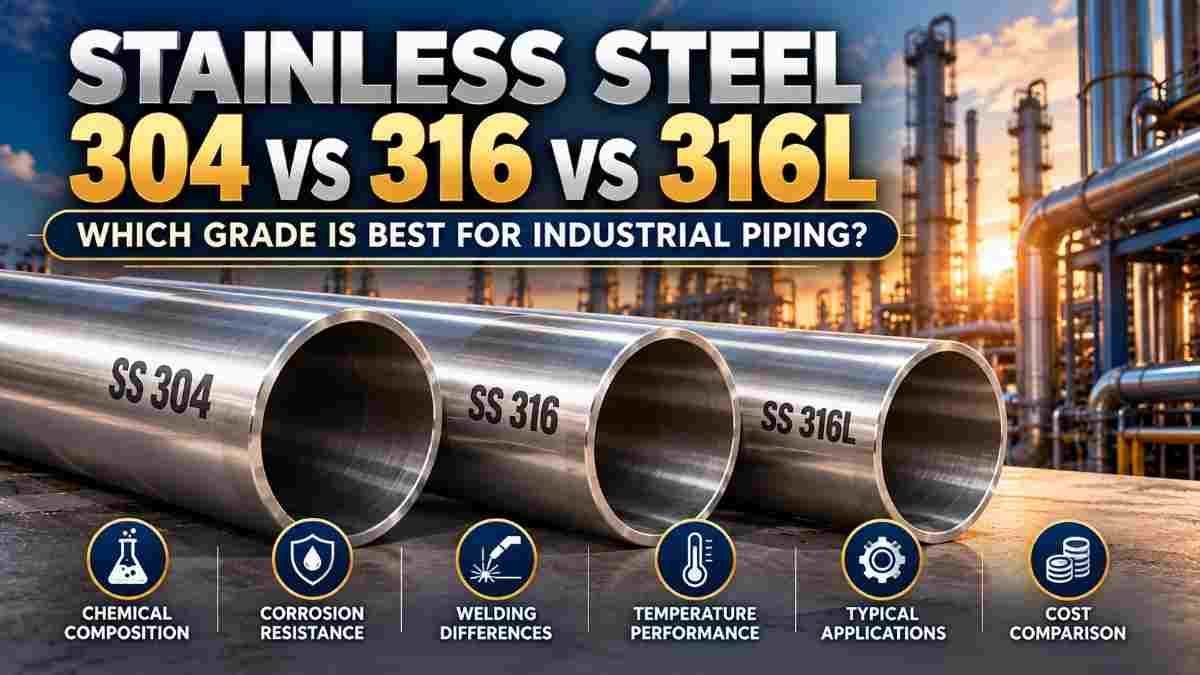
Choosing the right stainless steel grade is an important decision when designing or purchasing industrial piping systems. Stainless steel 304, 316, and 316L are widely used austenitic stainless steels, but differences in chemical composition and corrosion resistance can influence their suitability for a particular application.
Industrial buyers often compare stainless steel 304 vs 316 vs 316L to determine which grade offers the right balance of corrosion resistance, fabrication performance, service life, and cost.
The main difference is that 316 and 316L contain molybdenum for improved resistance to certain forms of localized corrosion, while 316L has a lower maximum carbon content than standard 316. Grade 304 is generally a cost-effective option for many less aggressive environments, while 316 and 316L may be preferable where chloride exposure or specific welding requirements justify the additional alloying cost.
However, no stainless steel grade is universally best. The correct choice depends on the chemical environment, temperature, pressure, fabrication method, maintenance requirements, and applicable engineering standards.
This guide explains the composition, corrosion performance, welding characteristics, industrial applications, and purchasing considerations of SS 304, SS 316, and SS 316L.
Stainless steel 304, 316, and 316L belong to the austenitic stainless steel family. These alloys contain chromium and nickel, which contribute to corrosion resistance and useful fabrication properties.
Chromium helps form a thin protective oxide film on the metal surface. This passive film can reform under suitable conditions, helping stainless steel resist corrosion.
However, different stainless steel grades respond differently to chlorides, chemicals, elevated temperatures, and welding operations.
Stainless steel 304 is a widely used chromium-nickel austenitic stainless steel. It offers a practical combination of corrosion resistance, strength, formability, and weldability.
Grade 304 is commonly considered for:
Shubham Metals offers 304 stainless steel electropolished pipes and tubes for applications where surface cleanliness and suitable corrosion resistance are important.
Stainless steel 316 is an austenitic chromium-nickel alloy that contains molybdenum, typically around 2–3%.
Molybdenum improves resistance to certain localized corrosion mechanisms, especially pitting and crevice corrosion in chloride-containing environments when compared with standard 304 stainless steel.
Grade 316 is frequently evaluated for chemical-processing equipment, marine-related components, and industrial systems requiring greater corrosion resistance than 304.
However, 316 is not immune to chloride corrosion, particularly under severe exposure conditions.
Stainless steel 316L is the low-carbon version of 316 stainless steel.
The letter L indicates a reduced maximum carbon content, typically 0.030% under common ASTM grade specifications.
This lower carbon limit helps reduce susceptibility to chromium carbide precipitation and associated intergranular corrosion during certain welding thermal cycles.
As a result, 316L is often selected for welded piping assemblies, fabricated equipment, and corrosive service where weld-related corrosion performance is important.
Buyers evaluating this grade can review Shubham Metals' 316L stainless steel tube product category for available specifications and supply enquiries.
The three grades share several characteristics but differ in composition, corrosion resistance, welding considerations, and typical purchasing cost.
| Property | SS 304 | SS 316 | SS 316L |
|---|---|---|---|
| UNS Designation | S30400 | S31600 | S31603 |
| Stainless Steel Family | Austenitic | Austenitic | Austenitic |
| Chromium | Typically 18–20% | Typically 16–18% | Typically 16–18% |
| Nickel | Typically 8–10.5% | Typically 10–14% | Typically 10–14% |
| Molybdenum | Not intentionally added | Typically 2–3% | Typically 2–3% |
| Maximum Carbon | 0.08% | 0.08% | 0.030% |
| Chloride Pitting Resistance | Lower relative resistance | Generally better than 304 | Generally comparable to 316 |
| Welding Considerations | Suitable for welding, with sensitization considerations | Suitable for welding, with sensitization considerations | Lower-carbon option for welded fabrication |
| Typical Material Cost | Generally lower | Generally higher than 304 | Often similar to 316, depending on supply |
The chemical composition values above are typical specification ranges for common wrought grades. The exact requirements depend on the applicable ASTM, ASME, EN, or other product standard.
Chemical composition directly affects corrosion resistance, mechanical behavior, and response to fabrication or heat exposure.
Three important alloying elements are chromium, nickel, and molybdenum.
Chromium contributes to formation of the passive oxide film that helps protect stainless steel surfaces.
This film is a major reason stainless steel resists corrosion in many environments.
However, the passive layer can break down under aggressive conditions, including some chloride-rich or acidic environments.
Nickel helps stabilize the austenitic microstructure and contributes to useful ductility and fabrication characteristics.
Both 304 and 316 contain nickel, although their specified ranges differ.
Nickel content is one factor affecting material performance, but it should not be used alone to judge corrosion suitability.
The molybdenum content of 316 and 316L improves resistance to localized corrosion, particularly pitting in certain chloride-containing solutions.
For this reason, 316-based materials are often considered when 304 may be inadequate.
However, the benefit depends on actual chloride concentration, temperature, oxygen availability, crevice conditions, and other environmental factors.
In many chloride-containing environments, stainless steel 316 and 316L offer better pitting and crevice-corrosion resistance than 304.
This advantage comes primarily from their molybdenum content.
In less aggressive environments, however, 304 may provide sufficient corrosion resistance at a lower material cost.
316 and 316L have broadly similar localized corrosion resistance when their other alloying elements and surface conditions are comparable. The lower carbon content of 316L mainly affects sensitization-related considerations rather than creating a substantial general improvement in chloride pitting resistance.
Grade 304 may be suitable for many water and utility systems where chloride levels, temperatures, flow conditions, and cleaning chemicals are compatible with the material.
However, 304 should not automatically be specified for every water application.
Water chemistry, stagnation, crevices, deposits, and disinfectant exposure can significantly influence corrosion behavior.
Grade 316 generally offers improved resistance to chloride-related pitting compared with 304.
Nevertheless, 316 can still suffer localized corrosion or chloride stress-corrosion cracking under unfavorable conditions.
For severe chloride exposure, engineers may need to evaluate duplex, super duplex, or other corrosion-resistant alloys.
Not necessarily in every environment.
316L has lower carbon content, which is particularly useful for reducing sensitization-related corrosion risks associated with certain welding or heat-exposure conditions.
Its molybdenum and chromium ranges are generally similar to 316, so their resistance to chloride pitting is usually broadly comparable.
Selection should therefore focus on the specific corrosion mechanism of concern.
The key distinction between 316 and 316L is their maximum carbon content.
During certain welding thermal cycles, chromium carbides can form at grain boundaries in susceptible stainless steel materials.
When this occurs, nearby regions may become depleted in chromium, potentially reducing resistance to intergranular corrosion.
316L's lower carbon content helps reduce the likelihood of this sensitization mechanism.
316L is frequently specified for welded pipes, fittings, and fabricated assemblies because the lower carbon content provides added resistance to sensitization under relevant conditions.
This can be valuable where corrosion resistance is important and post-weld heat treatment is impractical.
However, selecting 316L does not eliminate the need for correct welding procedures, suitable filler metals, weld cleaning, and inspection.
Yes. Stainless steel 316 can be welded using suitable procedures.
Its suitability depends on the joint design, service environment, welding process, and applicable fabrication standard.
316L may offer a practical advantage for certain welded constructions, but standard 316 is not inherently unsuitable for welding.
304L offers a similar low-carbon advantage relative to standard 304.
For projects where molybdenum-enhanced corrosion resistance is unnecessary but low-carbon material is desirable, 304L may be worth considering.
Shubham Metals also lists 304L stainless steel pipes for relevant industrial piping requirements.
The best grade for elevated-temperature service depends on operating temperature, pressure, exposure duration, corrosion environment, and applicable design-code requirements.
It is not correct to assume that 316L is always better at elevated temperatures simply because it offers low-carbon welding benefits.
In some high-temperature pressure applications, the mechanical strength requirements may favor other specified grades, including high-carbon variants such as 304H or 316H.
Prolonged heat exposure may also create concerns involving creep strength, microstructural changes, oxidation, or thermal fatigue.
For elevated-temperature piping, buyers should evaluate:
Grade selection for high-temperature pressure service should be approved through the project's engineering design process.
Both 304 and 316L are used in food-processing and pharmaceutical equipment, depending on the application.
The correct selection depends on process fluids, cleaning chemicals, operating temperatures, hygienic requirements, and surface finish.
Grade 304 can be suitable for food-processing equipment, storage vessels, and piping systems where the process environment is compatible with the alloy.
However, products containing significant chloride concentrations or involving aggressive cleaning conditions may require a different grade.
316L is often selected for pharmaceutical and high-purity process piping because it offers molybdenum-enhanced corrosion resistance together with low-carbon fabrication characteristics.
Surface finish, weld quality, drainability, cleaning procedures, and compliance with applicable hygienic standards remain essential.
A 316L designation alone does not establish that a component is suitable for every pharmaceutical application.
Electropolishing removes a controlled amount of surface material and can improve smoothness and surface cleanliness when properly performed.
It may help reduce surface imperfections and improve cleanability in suitable high-purity applications.
However, electropolishing does not change the underlying stainless steel grade or make the pipe immune to corrosion.
Buyers requiring specialized finishes can review Shubham Metals' electropolished 304 stainless steel products and confirm the required surface specifications for their project.
316 and 316L are frequently considered for marine-related components because they generally offer better resistance to chloride pitting than 304.
However, the term marine environment covers many different exposure conditions.
Atmospheric salt exposure is different from continuous seawater immersion, stagnant seawater, warm seawater, or crevice-prone assemblies.
316 stainless steel is not universally suitable for continuous seawater service.
For demanding seawater systems, higher-alloy stainless steels, duplex materials, or other alloys may be necessary.
There is no single stainless steel grade suitable for all industrial chemicals.
Corrosion behavior depends on chemical concentration, temperature, impurities, oxygen content, and operating conditions.
316 and 316L may perform better than 304 in certain chemical environments, but some acids and chloride-rich conditions can attack all three grades.
Before selecting a pipe material, engineers should evaluate corrosion data specific to the process medium and operating conditions.
Where 304 or 316-based alloys are not suitable, the project may require specialized corrosion-resistant materials.
| Application | Grade Worth Evaluating | Main Selection Consideration |
|---|---|---|
| General utility piping | 304 | Suitable corrosion resistance at economical cost |
| Food-processing lines | 304 or 316L | Product chemistry, cleaning conditions, hygienic design |
| Pharmaceutical piping | 316L | Corrosion resistance, fabrication, surface finish |
| Chemical-processing equipment | 316 or 316L, where compatible | Specific chemical compatibility |
| Coastal atmospheric exposure | 316 or 316L | Salt deposition, maintenance, crevice exposure |
| Heavily welded process piping | 316L where molybdenum is required | Sensitization and weld corrosion considerations |
| High-temperature pressure piping | Engineering assessment required | Code allowable stress and temperature limitations |
| Continuous seawater systems | Higher-alloy alternatives may be needed | Severe chloride exposure and crevice corrosion |
This table provides general selection guidance, not final material approval for a specific engineering system.
316 and 316L are generally more expensive than 304 because their composition includes molybdenum and higher specified nickel ranges.
Actual prices depend on market conditions, product form, size, quantity, grade availability, and manufacturing method.
Industrial buyers should compare more than the initial price per kilogram.
Other factors influencing total purchasing cost include:
A higher-alloy grade may provide better lifecycle value when it prevents corrosion-related failures in a suitable application.
However, specifying 316 or 316L where 304 is fully adequate may increase costs without a corresponding practical benefit.
A simplified raw material cost calculation can help buyers compare grades.
Estimated Material Cost = Pipe Weight × Price per Kilogram
For example, consider a hypothetical requirement of 500 kg of stainless steel pipe.
| Material Grade | Illustrative Price per Kg | Estimated Cost for 500 Kg |
|---|---|---|
| SS 304 | ?200 | ?100,000 |
| SS 316 | ?300 | ?150,000 |
| SS 316L | ?315 | ?157,500 |
These prices are hypothetical calculation examples and are not current Shubham Metals quotations or verified market prices.
Actual procurement costs should be confirmed through an itemized quotation based on the specified pipe dimensions, quantity, testing, and delivery requirements.
Industrial stainless steel piping must comply with the material specifications and construction codes applicable to the project.
Examples of commonly used specifications include:
| Standard | General Scope |
|---|---|
| ASTM A312 / A312M | Seamless, welded, and heavily cold-worked austenitic stainless steel pipes |
| ASTM A269 / A269M | Seamless and welded austenitic stainless steel tubing for general service |
| ASTM A213 / A213M | Seamless ferritic and austenitic alloy-steel boiler, superheater, and heat-exchanger tubes |
| ASTM A270 / A270M | Seamless and welded austenitic and ferritic/austenitic stainless steel sanitary tubing |
| ASTM A403 / A403M | Wrought austenitic stainless steel piping fittings |
The relevant standard depends on whether the order involves pipes, tubes, fittings, or a specialized product form.
A buyer should not assume that a single ASTM specification applies to every product manufactured from stainless steel 304, 316, or 316L.
Shubham Metals lists stainless steel pipes in multiple grades, forms, dimensions, and finishes for industrial procurement requirements.
Material grade alone is not enough to prepare a complete industrial pipe purchase order.
Buyers should specify the required product characteristics and documentation.
Identify the exact grade, UNS designation, product standard, and any supplementary requirements.
For example, ASTM A312 TP316L is more specific than simply requesting a 316L stainless steel pipe.
Confirm the nominal pipe size, outside diameter, schedule or wall thickness, and required length.
Dimensions must meet the applicable dimensional and project specifications.
Seamless and welded pipes have different manufacturing processes, availability, cost, and inspection considerations.
Neither type is universally superior for every application.
Selection should be based on the relevant material standard, design requirements, operating conditions, and project specifications.
Depending on the application, stainless steel pipes may require pickled, annealed, polished, bright-annealed, or electropolished surfaces.
Surface finish can influence cleanability, appearance, and corrosion performance.
Typical procurement requirements may include:
The exact testing and documentation requirements should match the applicable product standard and purchase order.
316L may be acceptable in some applications originally considering 316, but substitution should never be automatic.
Differences in specified mechanical properties, design-code requirements, and service conditions must be considered.
For pressure equipment or piping governed by a code, material substitution should be approved by the responsible engineer.
Likewise, replacing 316L with standard 316 in a welded assembly requires consideration of the intended corrosion performance and welding conditions.
Common material-selection mistakes include:
A complete engineering and procurement review helps reduce the likelihood of ordering unsuitable materials.
316 stainless steel contains molybdenum, which generally provides better resistance to localized chloride corrosion than 304. Grade 304 may be more economical for environments where this additional resistance is unnecessary.
316L has lower maximum carbon content and is often preferred for welded fabrication where reducing sensitization-related corrosion risk is important. Its chloride pitting resistance is generally similar to that of 316 when their compositions and surface conditions are comparable.
SS 304 is generally less expensive than SS 316 because 316 contains additional alloying elements, particularly molybdenum. Actual prices vary with market conditions and product specifications.
316L is austenitic and is generally considered nonmagnetic in the solution-annealed condition. However, cold working and processing can introduce some magnetic response.
304 may be inadequate for many chloride-rich marine environments. Grade 316 may offer better resistance in certain marine atmospheric conditions, but severe seawater applications can require more corrosion-resistant alloys.
316L is widely considered for hygienic and high-purity process systems. However, suitability also depends on surface finish, weld quality, cleaning chemicals, process conditions, and relevant industry standards.
Under common ASTM grade specifications, 316L has a maximum carbon content of 0.030%, compared with 0.08% for standard 316.
Not necessarily. Lower-carbon 316L can have different specified minimum strength requirements from standard 316. The relevant product specification and design code should be checked for the required application.
There is no universal best grade for chemical plants. Material selection depends on the chemical medium, concentration, temperature, pressure, and corrosion mechanisms involved.
Both may be suitable depending on the product standard and service requirements. The decision should consider pressure design, dimensions, inspection, fabrication, cost, and project specifications.
Stainless steel 304, 316, and 316L each offer useful properties for industrial piping, but the best option depends on the application.
Grade 304 is often a cost-effective choice for general service in compatible environments. Grade 316 provides improved localized corrosion resistance in many chloride-containing conditions, while 316L offers a lower-carbon alternative often selected for welded fabrication.
Before ordering, buyers should evaluate process chemistry, operating temperature, pressure requirements, product standards, material traceability, and inspection requirements.
Shubham Metals supplies stainless steel pipes, tubes, and fittings for different industrial requirements, including grades 304, 304L, 316, and 316L.
To discuss pipe grades, sizes, schedules, material certificates, and availability, explore the company's stainless steel pipe product range and request a quotation based on your project's technical specifications.