
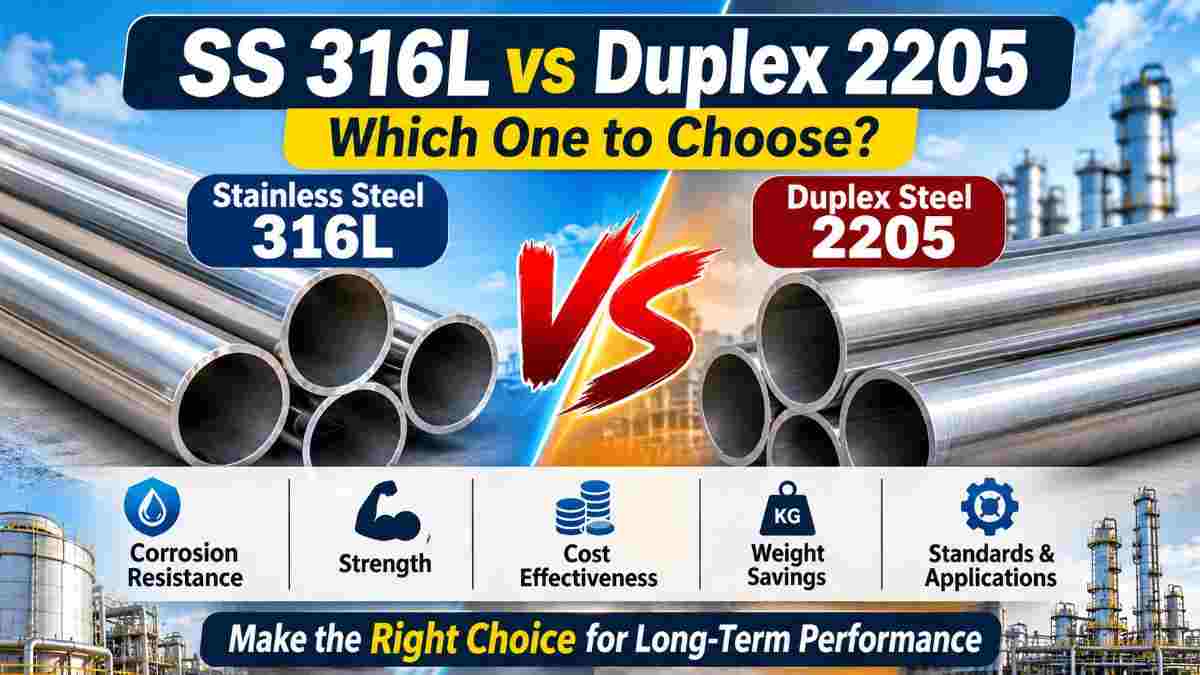
Selecting between stainless steel 316L and duplex 2205 (UNS S32205 / S31803) is one of the most consequential material decisions in chemical processing, desalination, marine engineering, and oil and gas piping. While 316L is the standard molybdenum-bearing austenitic stainless steel for general corrosion resistance, warm chloride environments and high operating pressures can trigger pitting, crevice corrosion, or chloride stress-corrosion cracking. Understanding when to stay with 316L and when to upgrade to Duplex 2205 allows engineers to balance upfront material cost against long-term service life and wall-thickness weight savings.
Duplex 2205 (UNS S32205 / S31803) combines a 50/50 austenitic-ferritic microstructure that delivers roughly twice the yield strength of Stainless Steel 316L alongside higher chromium, molybdenum, and nitrogen levels for superior pitting and chloride stress-corrosion resistance, whereas 316L offers lower initial material cost and easier cold formability for standard corrosive duties.
Yield Strength Advantage: Duplex 2205 offers a minimum 0.2% yield strength around 450 MPa compared to roughly 170–205 MPa for annealed 316L, enabling thinner pipe schedules under high internal pressure.
Localized Corrosion Resistance: Higher chromium (22% vs. 16–18%), molybdenum (3.0–3.5% vs. 2.0–3.0%), and nitrogen (0.14–0.20%) push Duplex 2205's Pitting Resistance Equivalent Number (PREN) to roughly 34–35, compared to 24–26 for 316L.
Total Installed Cost: Although Duplex 2205 carries a higher per-kilogram price, thinner wall schedules and reduced weld filler consumption often narrow the total installed cost on high-pressure headers.
Stainless Steel 316L (UNS S31603) is sufficient for pharmaceutical processing, food and beverage lines, clean water systems, mild organic acids, and ambient-temperature chemical transfer where chloride concentrations stay moderate and operating temperatures remain below the threshold for chloride stress-corrosion cracking.
Low-Carbon Weld Integrity: With carbon capped at 0.03% maximum, Stainless Steel 316 / 316L Pipe resists sensitization and intergranular corrosion in the heat-affected zone without requiring post-weld annealing.
Cryogenic & High-Temperature Versatility: Unlike ferritic-austenitic duplex grades, austenitic 316L retains impact toughness down to cryogenic temperatures and can operate above 315°C without embrittlement.
Readily Available Fittings & Valves: Standard ASTM A312 pipes and ASTM A403 WP316L fittings provide fast turnaround for general plant maintenance and low-to-medium pressure utility networks.
Upgrading to Duplex 2205 is justified when piping carries brackish water, seawater, brine, sour hydrocarbons, or warm chloride-bearing chemicals above 50–60°C, or when high design pressures allow engineers to step down pipe wall schedules and cut structural support loads.
Chloride Stress-Corrosion Cracking (CSCC) Immunity: Austenitic 316L becomes vulnerable to CSCC in tensile-stressed piping exposed to chlorides above roughly 60°C, whereas Duplex Steel S32205 Pipe resists cracking across typical marine and chemical operating windows.
Weight & Space Reduction: Twice the design allowable stress permits lighter schedules (such as stepping down from Sch 80 to Sch 40) on offshore topsides, desalination skids, and long pipe racks.
Matched Piping Geometry: Pairing seamless or welded duplex pipes with Duplex Steel S31803 / S32205 Buttweld Fittings ensures uniform corrosion resistance and mechanical strength across every elbow, tee, and reducer.
Stainless Steel 316L pipes and fittings follow ASTM A312 and ASTM A403, whereas Duplex 2205 pipes and fittings are governed by ASTM A790 (seamless and welded pipe), ASTM A789 (heat-exchanger tubing), and ASTM A815 (wrought buttweld fittings), requiring controlled heat input during welding and ferrite-balance verification.
Controlled Welding Heat Input: Duplex 2205 must be welded using over-alloyed filler metals (such as ER2209) with strict interpass temperature limits (typically below 150°C) to preserve the 40–60% ferrite-austenite phase balance and prevent brittle intermetallic phases.
Operating Temperature Ceiling: Standard Duplex 2205 is restricted to service temperatures below 300–315°C to avoid 475°C embrittlement.
Mandatory Mill & NDT Verification: Buyers should specify EN 10204 3.1 Mill Test Certificates (MTC), Positive Material Identification (PMI), ASTM G48 pitting corrosion testing (for Duplex), hydrostatic pressure testing, and NACE MR0175 / ISO 15156 compliance where sour service applies.
Shubham Metals manufactures and stocks ASTM A312 Stainless Steel 316/316L and ASTM A790 Duplex S31803/S32205 seamless and welded pipes, tubes, buttweld fittings, forged fittings, and flanges in Bengaluru for immediate domestic dispatch and international export.
Every order includes complete heat-number traceability, EN 10204 3.1 MTCs, PMI verification, and third-party inspection coordination (TUV, SGS, Lloyds, and DNV) tailored to your project specifications. Browse additional alloy selection guides on the Shubham Metals Blog, learn more about our quality systems on our About Us page, or call +91-97393-33696 / +91-80-41263159 to share your bill of materials today.