
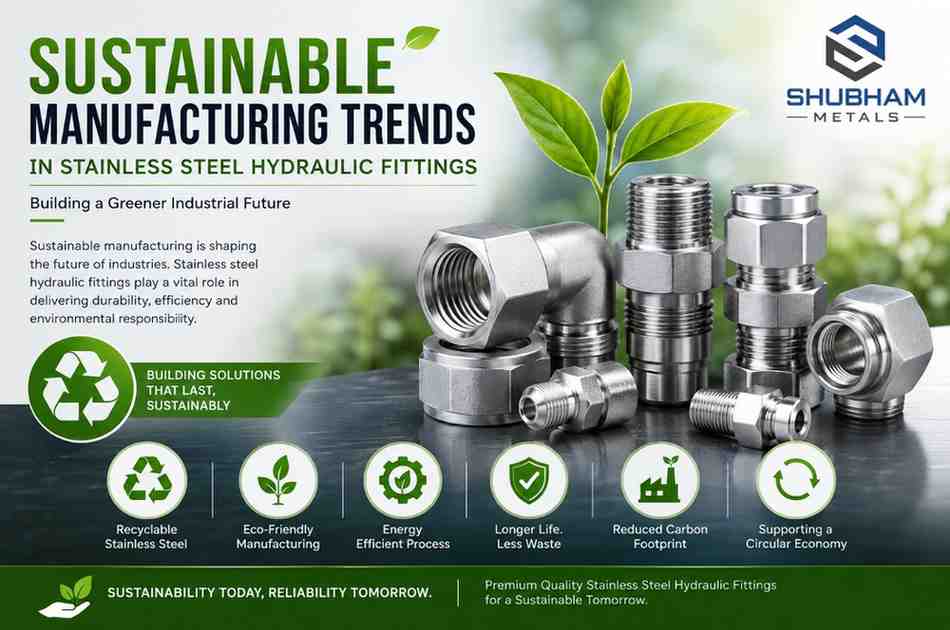
As industries worldwide focus on reducing environmental impact, sustainability has become a key factor in manufacturing decisions. From energy-efficient production methods to recyclable materials, businesses are seeking solutions that support both operational performance and environmental responsibility.
One component playing a significant role in this transformation is stainless steel hydraulic fittings. Known for their durability, corrosion resistance, and long service life, these fittings contribute to sustainable hydraulic systems across industries such as oil & gas, chemical processing, marine, food processing, pharmaceuticals, and renewable energy.
At Shubham Metals, we understand the growing demand for environmentally responsible industrial solutions. By delivering high-quality stainless steel hydraulic fittings, we help industries improve efficiency while supporting their sustainability goals.
Sustainability begins with material selection. Stainless steel is one of the most environmentally friendly engineering materials available today.
Unlike lower-grade materials that require frequent replacement, stainless steel hydraulic fittings can perform reliably for years, reducing resource consumption and operational costs.
Global industries are increasingly adopting green manufacturing practices to meet environmental regulations and customer expectations.
As a result, manufacturers are investing in sustainable production technologies and premium-grade stainless steel components that offer long-term value.
One of the most significant trends in sustainable manufacturing is the incorporation of recycled stainless steel into production processes.
Modern stainless steel can contain a substantial percentage of recycled material while maintaining the same strength, durability, and corrosion resistance as virgin steel.
Manufacturers that prioritize recycled materials contribute significantly to reducing the environmental impact of industrial production.
Advanced manufacturing technologies are helping reduce energy consumption during the production of stainless steel hydraulic fittings.
These innovations allow manufacturers to produce precision hydraulic fittings while minimizing energy use and production waste.
Modern hydraulic fitting manufacturing relies heavily on precision engineering.
Using advanced machining systems and digital design tools enables manufacturers to:
Precision manufacturing not only improves product quality but also supports sustainability by reducing unnecessary material consumption.
Product longevity is one of the most overlooked aspects of sustainability.
High-quality stainless steel hydraulic fittings can withstand:
Because they last significantly longer than alternative materials, industries benefit from reduced replacement frequency and lower environmental impact.
Fewer replacements mean:
Industry 4.0 technologies are transforming the hydraulic fitting manufacturing sector.
These technologies improve production efficiency while reducing waste, energy consumption, and operational inefficiencies.
Smart manufacturing helps create a more sustainable supply chain from raw material sourcing to final product delivery.
Traditional finishing processes often involve chemicals that can impact the environment.
Today, manufacturers are adopting environmentally responsible alternatives such as:
These improvements enhance the corrosion resistance of stainless steel hydraulic fittings while minimizing environmental impact.
The renewable energy sector is becoming a major consumer of stainless steel hydraulic fittings.
Applications include:
Hydraulic systems in wind turbines rely on corrosion-resistant fittings for long-term reliability.
Hydraulic control systems use stainless steel components for durability and reduced maintenance.
High-pressure hydraulic systems require robust fittings capable of operating in demanding environments.
As renewable energy investments grow worldwide, demand for sustainable hydraulic components continues to increase.
Hydraulic fluid leakage not only affects system performance but also creates environmental concerns.
Modern stainless steel hydraulic fittings are engineered to provide:
Reducing fluid leakage helps industries minimize waste, prevent contamination, and improve operational efficiency.
The industrial sector is increasingly embracing circular economy principles.
Stainless steel hydraulic fittings support this approach because they can:
This reduces landfill waste and supports sustainable resource management.
Leading manufacturers are evaluating sustainability throughout their supply chains.
Important considerations include:
Companies that prioritize sustainable supply chains are better positioned to meet evolving customer and regulatory expectations.
Not all hydraulic fittings offer the same environmental benefits.
Poor-quality fittings often result in:
Investing in premium-grade stainless steel hydraulic fittings delivers long-term sustainability benefits while improving operational reliability.
At Shubham Metals, quality, durability, and customer satisfaction are at the core of everything we do.
Our stainless steel hydraulic fittings are manufactured to meet demanding industrial requirements while supporting modern sustainability objectives.
We are committed to helping industries achieve greater efficiency, safety, and sustainability through superior hydraulic fitting solutions.
Sustainability is no longer a future goal—it is a present-day necessity. The stainless steel hydraulic fittings industry is rapidly evolving through innovations in recycled materials, energy-efficient manufacturing, smart technologies, precision engineering, and circular economy practices.
By choosing high-quality stainless steel hydraulic fittings, businesses can reduce waste, improve system reliability, lower maintenance costs, and support environmental responsibility.
As a trusted manufacturer and supplier, Shubham Metals continues to provide durable, high-performance stainless steel hydraulic fittings that align with the growing demand for sustainable industrial solutions.
For industries seeking reliability, efficiency, and long-term sustainability, stainless steel hydraulic fittings remain one of the smartest investments for the future.