
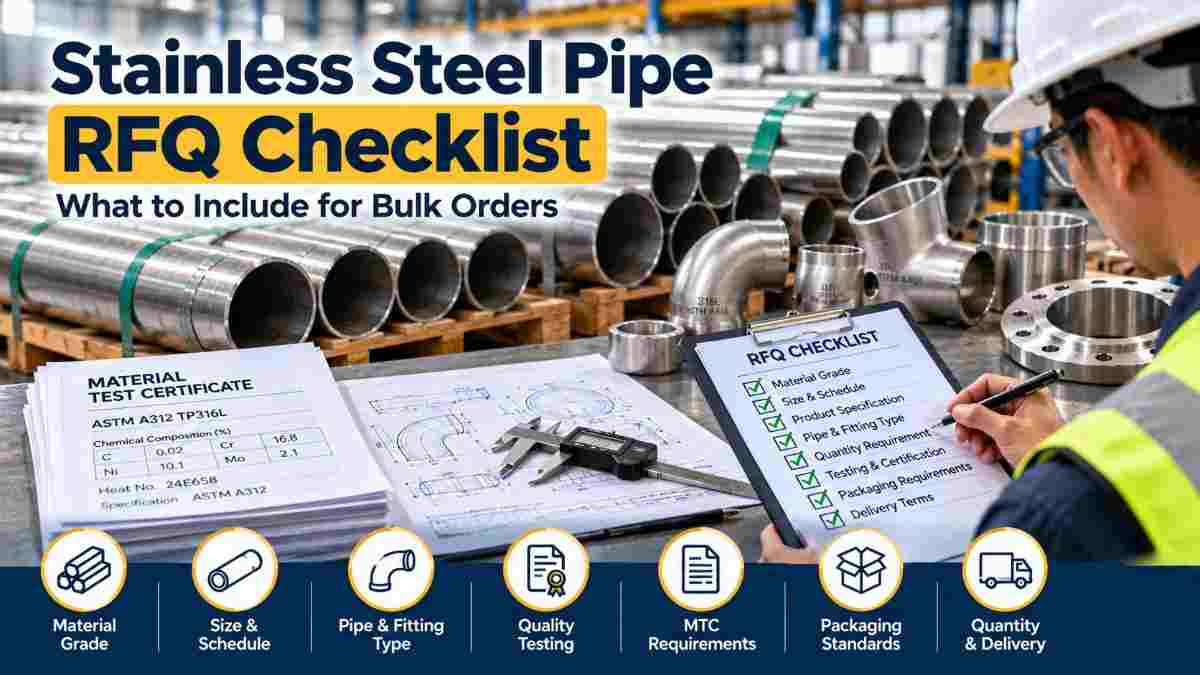
Are you preparing to purchase stainless steel pipes and fittings for an industrial project but unsure what technical information to include in your supplier enquiry? An incomplete Request for Quotation (RFQ) can result in inaccurate pricing, unsuitable materials, missing certifications, and unnecessary procurement delays.
A stainless steel pipe RFQ should include the material grade, manufacturing specification, nominal pipe size, wall thickness or schedule, manufacturing method, quantity, testing requirements, certification, packaging, and delivery terms. For fittings, buyers must also specify the fitting type, dimensions, connection method, and applicable dimensional standard.
A detailed RFQ allows suppliers to understand the required materials and provide quotations based on consistent specifications.
Shubham Metals supplies stainless steel pipes, alloy steel products, fittings, flanges, and other industrial metal materials to engineering companies, manufacturers, and procurement teams.
This stainless steel pipe RFQ checklist explains how to prepare a bulk purchasing enquiry, choose appropriate specifications, request material documentation, and compare supplier quotations.
A stainless steel pipe RFQ checklist should cover product specifications, material grades, pipe dimensions, manufacturing requirements, inspection documents, quantities, packaging, and delivery conditions. Providing complete information helps suppliers quote the correct product.
Before sending your RFQ, include:
Product description: Stainless steel seamless pipe, welded pipe, or the required fitting type.
Material grade: Specify the exact stainless steel designation.
Manufacturing standard: Identify the applicable ASTM, ASME, EN, or other specification.
Nominal pipe size: Provide NPS or DN.
Wall thickness: Specify the required pipe schedule or actual wall thickness.
Manufacturing method: Indicate seamless, welded, or another approved construction.
Length: Specify the required pipe lengths.
End preparation: Identify plain, beveled, threaded, or other required ends.
Quantity: State the total pieces, lengths, or weights required.
Inspection: Specify relevant testing and examination requirements.
Documentation: Identify required material certificates and traceability records.
Packaging: Provide handling, protection, and marking instructions.
Delivery: State the destination and required delivery terms.
Buyers can explore the Stainless Steel Pipe Product Range at Shubham Metals before preparing a quotation request.
A detailed RFQ is important because it reduces uncertainty about product specifications, makes supplier quotations easier to compare, and helps prevent material-ordering errors.
Industrial stainless steel pipes may appear similar while differing in chemical composition, wall thickness, manufacturing standards, or inspection requirements.
An incomplete enquiry can create problems such as:
Incorrect material grades.
Unspecified wall thickness.
Quotations based on different manufacturing methods.
Missing testing requirements.
Incompatible pipe fittings.
Unexpected fabrication costs.
Unclear shipping responsibilities.
Delayed technical approval.
A properly prepared RFQ should allow multiple suppliers to quote against the same technical and commercial requirements.
You should specify the exact stainless steel grade approved for the application rather than using a general description such as "stainless steel pipe." Different grades offer different mechanical properties, corrosion resistance, and temperature performance.
Commonly requested austenitic stainless steel grades include:
304: Used in many general industrial applications where its corrosion resistance is suitable.
304L: A low-carbon version of 304, often specified for welded applications.
316: Contains molybdenum and may provide improved resistance to certain corrosive environments compared with 304.
316L: A low-carbon version of 316 commonly selected for welded piping.
321: A titanium-stabilized stainless steel used for certain elevated-temperature applications.
310: Used in selected high-temperature environments, subject to grade-specific limitations.
Material selection must consider the process fluid, temperature, pressure, corrosion mechanisms, and applicable design code.
When possible, include the complete material designation.
For example, a purchasing specification for certain austenitic stainless steel pipes may identify ASTM A312 TP316L rather than simply stating "316L pipe."
Shubham Metals lists multiple stainless steel grades on its Stainless Steel Pipe page.
The RFQ should identify both the applicable material or manufacturing specification and the dimensional standard. These documents serve different purposes and help define what the supplier must deliver.
Common standards include:
ASTM A312/A312M covers seamless, welded, and heavily cold-worked austenitic stainless steel pipes intended for specified high-temperature and general corrosive service applications.
It includes requirements concerning materials, manufacture, mechanical properties, and applicable testing.
The specification does not apply to every stainless steel product or fitting.
ASME B36.19 defines standardized dimensions for welded and seamless wrought stainless steel pipes, including nominal outside diameters and wall thicknesses.
It is used with relevant product specifications to identify pipe dimensions.
The dimensional standard alone does not determine allowable operating pressure.
ASTM A403/A403M covers wrought austenitic stainless steel piping fittings for pressure piping applications.
It may be specified for applicable butt-weld fittings, depending on the selected material and product requirements.
Other fitting types may be governed by different specifications.
ASME B16.9 is a commonly used dimensional standard for factory-made wrought butt-welding fittings.
Buyers should confirm whether the order requires ASME B16.9, MSS SP-43, or another applicable standard.
These requirements should be identified explicitly rather than assumed from the product description.
Specify the Nominal Pipe Size (NPS) or DN designation together with the required wall thickness or schedule and applicable dimensional standard. NPS alone is not enough to define the internal dimensions of a pipe.
For example, an RFQ might specify:
Product: Stainless steel seamless pipe.
Material: ASTM A312 TP316L.
Nominal size: NPS 4.
Schedule: 40S.
Dimensional standard: ASME B36.19.
This identifies a much more specific product than a request for a "4-inch stainless steel pipe."
The selected schedule must match the engineering design.
Avoid assuming that higher schedule numbers are always necessary or that one schedule is suitable for every pressure condition.
Pipe schedule is a standardized wall-thickness designation, while actual wall thickness is a measurable dimension subject to the manufacturing requirements and tolerances of the product specification.
Common stainless steel pipe schedules include:
Schedule 5S.
Schedule 10S.
Schedule 40S.
Schedule 80S.
Other wall thicknesses may be available under applicable standards and product arrangements.
When purchasing, verify:
Nominal pipe size.
Schedule designation.
Nominal wall thickness.
Applicable dimensional standard.
Minimum permitted wall thickness.
Product manufacturing tolerances.
If the engineering design requires a specific minimum wall thickness, that requirement should be addressed explicitly in the purchase specification.
Yes. Buyers should specify seamless or welded construction when the engineering specification requires a particular manufacturing method. These products are manufactured differently and may have different inspection and procurement considerations.
Seamless pipes are manufactured without a longitudinal weld seam.
Welded pipes are produced using a welding process, typically from formed metal stock.
Both may be suitable for industrial applications when they meet the relevant product specifications and design requirements.
When choosing the manufacturing method, consider:
Applicable project requirements.
Design pressure and temperature.
Product specification.
Inspection requirements.
Dimensions.
Material availability.
Fabrication requirements.
Total procurement cost.
Neither construction method should be treated as universally superior.
A stainless steel fitting RFQ should identify the fitting type, nominal size, wall thickness or pressure class, material grade, connection type, dimensional standard, and required quantity.
Common fitting types include:
45-degree elbows.
90-degree elbows.
Equal tees.
Reducing tees.
Concentric reducers.
Eccentric reducers.
End caps.
Couplings.
Socket-weld fittings.
Threaded fittings.
Fittings should be compatible with the adjoining pipe dimensions and the engineering requirements.
For elbows, specify the nominal size, material grade, angle, radius type, wall thickness, dimensional standard, and quantity.
For example, a project may require a 90-degree long-radius butt-weld elbow.
The correct fitting depends on the approved piping layout.
For tees, specify whether the fitting is equal or reducing, along with all required branch and run sizes, material specifications, wall thicknesses, and quantities.
An equal tee and a reducing tee are not interchangeable.
For reducers, specify whether the design is concentric or eccentric and provide the larger and smaller connection sizes.
The correct configuration depends on the piping arrangement and process requirements.
For socket-weld and threaded fittings, specify the connection type, nominal size, material grade, pressure class, and governing dimensional standard.
These fittings may have different requirements from butt-welding fittings.
An RFQ should not combine different connection types without clearly identifying each line item.
Pipe length and end preparation should be stated clearly because they affect fabrication, handling, installation, and supplier pricing.
Common pipe length requirements include:
Single random lengths.
Double random lengths.
Fixed lengths.
Custom cut lengths.
End preparations may include:
Plain ends.
Beveled ends.
Threaded ends, where applicable.
Other project-specific preparations.
For fixed-length orders, buyers should specify acceptable length tolerances.
If special machining, threading, or cutting is required, include the necessary technical details or drawings.
The required stainless steel pipe surface finish depends on the application, manufacturing process, cleanliness requirements, and project specifications.
Common finishes may include:
Annealed and pickled.
Mechanically polished.
Bright annealed, where available.
Other specified finishes.
For hygienic or specialized processing systems, surface finish requirements may be particularly important.
An RFQ should identify any required roughness values or inspection criteria rather than simply describing a finish as "smooth."
If surface condition is not critical to the application, use the finish permitted by the approved specification.
Request the material test certificates required by the project specification, purchase order, and applicable standards. These documents provide evidence supporting material identification and required test results.
A Mill Test Certificate may include:
Manufacturer identification.
Material grade.
Product specification.
Heat number.
Chemical composition.
Mechanical test results.
Product dimensions.
Heat treatment information.
Applicable supplementary inspection results.
An EN 10204 Type 3.1 certificate reports results from specific inspection and is validated by the manufacturer's authorized inspection representative independent of production.
It is commonly requested for industrial metallic materials where the purchase specification requires this type of inspection certificate.
An EN 10204 Type 3.2 certificate includes specific inspection results with additional validation by an appropriately authorized purchaser's representative or designated inspector under the standard.
The required certificate type depends on the project.
For additional guidance, read What Is a Mill Test Certificate? EN 10204 3.1 vs 3.2 Explained.
The RFQ should identify all tests required by the product specification, engineering design, and project quality plan. Not every test is necessary or applicable to every stainless steel pipe or fitting.
Potential requirements include:
Positive Material Identification.
Hydrostatic testing.
Ultrasonic examination.
Eddy current testing.
Radiographic examination.
Tensile testing.
Hardness testing.
Intergranular corrosion testing.
Other specified examinations.
Request PMI when the project requires additional verification of alloy composition or material identification.
PMI can help identify certain alloying elements, but the selected method has limitations.
For example, conventional handheld XRF does not reliably measure carbon content, so it cannot independently establish a low-carbon stainless steel designation.
Request hydrostatic testing when required by the applicable manufacturing specification or project requirements, accounting for permitted testing alternatives.
The test pressure, procedure, and acceptance criteria must follow the governing requirements.
Request ultrasonic or radiographic examination when the relevant product standard, engineering specification, or project inspection plan requires it.
These methods serve different inspection purposes.
Specify the applicable testing standards, examination extent, acceptance criteria, and documentation requirements.
Shubham Metals describes its material inspection capabilities on the Quality Assurance and Testing page.
Heat number traceability should be established through consistent material markings, certificates, and documented identification records.
This is particularly important when a shipment contains multiple heats or material grades.
Your RFQ should specify:
Required product markings.
Heat number identification.
Certificate traceability.
Handling of cut lengths.
Packaging identification.
Traceability requirements for fittings.
Any additional project-specific tracking.
Before accepting delivery, the buyer should be able to connect the materials to their applicable inspection documents.
Specify quantities using clear units such as pieces, total length, or weight, and ensure that each line item can be priced consistently.
For example, a pipe RFQ may identify the quantity in pieces and the required length of each piece.
Important details include:
Total number of pipes.
Length per pipe.
Total required length.
Quantity per material grade.
Quantity per size and schedule.
Separate quantities for each fitting type.
Permitted quantity tolerances.
Avoid requests such as "approximately 100 pipes" when the exact size, length, and quantity are needed for quotation.
Packaging requirements should protect the ordered pipes and fittings during transportation, storage, and handling while preserving material identification and surface condition.
Depending on the product and destination, requirements may include:
End caps.
Protective wrapping.
Suitable bundling.
Material segregation.
Waterproof packaging where required.
Product identification tags.
Shipping marks.
Secure palletization or crating.
Protection from contamination.
Export packaging requirements.
For stainless steel products, the packing and handling methods should help reduce the risk of mechanical damage and contamination from unsuitable materials.
Shubham Metals describes its industrial material packaging and logistics capabilities on its official website.
A bulk stainless steel pipe RFQ should specify the delivery destination, required delivery date, shipping responsibilities, and applicable commercial terms.
For international procurement, buyers should identify the agreed Incoterms rule and named place or port.
Important information includes:
Delivery location.
Required shipping date.
Applicable Incoterms.
Freight responsibility.
Insurance responsibility.
Packaging requirements.
Required shipping documents.
Inspection arrangements.
Partial shipment conditions.
Customs documentation requirements.
A quotation should make clear which costs are included and which remain the buyer's responsibility.
Compare supplier quotations using identical technical specifications and a consistent commercial evaluation process. Unit price alone may not reflect the full cost of procurement.
Review:
Confirm that all suppliers are quoting the same grade, manufacturing standard, dimensions, schedule, and construction method.
Different materials or wall thicknesses should not be compared as equivalent products.
Check whether each quotation includes the required certificates, testing, traceability, and inspection arrangements.
Missing documentation may create additional costs or acceptance problems.
Compare prices using the same quantity units, currency, delivery terms, and scope of supply.
Clarify cutting, testing, packing, and freight charges.
Compare documented availability, manufacturing lead time, inspection time, and dispatch arrangements.
Do not assume that stock availability guarantees arrival by a particular date.
Evaluate product specialization, communication, technical documentation, quality procedures, and order-handling arrangements.
A reliable supplier should clearly identify the products and terms being offered.
The most common RFQ mistakes are incomplete material specifications, missing dimensions, unclear testing requirements, and inconsistent quotation terms.
Avoid:
Writing "stainless steel pipe" without specifying the grade.
Omitting the manufacturing standard.
Specifying NPS without wall thickness or schedule.
Confusing pipe and tube dimensions.
Failing to state seamless or welded construction where required.
Omitting fitting connection details.
Using inconsistent quantity units.
Forgetting required material certificates.
Leaving PMI or NDT requirements unclear.
Failing to specify packaging.
Omitting the delivery destination.
Comparing quotations with different scopes.
A complete procurement checklist helps reduce these errors.
Shubham Metals supplies stainless steel pipes, industrial fittings, and related metal products for engineering and manufacturing requirements.
Established in 2013 and based in Bangalore, India, the company describes its activities as supplying, stocking, importing, and exporting industrial metal products.
Its stainless steel pipe range includes multiple grades, sizes, schedules, manufacturing options, and finishing requirements.
The company also publishes information about:
Material identification.
Quality testing.
Dimensional verification.
Material certification.
Technical documentation.
Packaging and logistics.
Buyers can review its Stainless Steel Pipe Collection and Quality Assurance Information before submitting technical requirements.
Product availability, testing, documentation, prices, and delivery terms should be confirmed for each order.
Common RFQ questions concern material grades, pipe dimensions, manufacturing specifications, certificates, quantities, and quotation requirements. The following answers address these procurement concerns.
An RFQ, or Request for Quotation, is a document sent to suppliers that describes the required stainless steel pipes, technical specifications, quantities, quality requirements, and commercial terms so suppliers can provide pricing.
An accurate quotation generally requires the material grade, manufacturing standard, NPS, wall thickness or schedule, pipe construction, length, quantity, testing requirements, and delivery location.
Yes. Multiple grades can be included in one RFQ when each line item clearly identifies its material specification, size, quantity, and other requirements.
No. ASTM A312/A312M covers specified austenitic stainless steel pipes. Other stainless steel product types and grades may fall under different manufacturing specifications.
NPS identifies the nominal pipe size, while schedule identifies nominal wall thickness for a specified size under the applicable dimensional standard.
Yes, when the project requires a particular manufacturing method. Otherwise, the request should clearly state any permitted alternatives.
Yes. Material certificates provide important evidence of product identification and required test results. The certificate type should match the purchase requirements.
Yes. Third-party inspection can be specified where required by the project or purchasing contract. The inspection scope, agency qualifications, timing, and responsibilities should be agreed upon.
No. PMI requirements depend on the project specifications, material identification risks, and applicable quality requirements.
Custom lengths may be available depending on product dimensions, material stock, cutting capabilities, and supplier arrangements. Availability should be confirmed during quotation.
Lead time depends on product availability, material specifications, order quantity, inspection requirements, processing, and shipping arrangements. Buyers should request a written delivery estimate.
Specify the complete material grade and manufacturing standard, require appropriate traceability, verify certificates, and perform receiving inspections and PMI where applicable.
You can request a bulk stainless steel pipe and fittings quotation from Shubham Metals by providing the complete material specifications, dimensions, quantities, inspection requirements, and delivery destination.
For a clear procurement enquiry, include:
Product description.
Material grade.
Manufacturing standard.
Nominal size.
Wall thickness or schedule.
Required lengths.
Fitting types and connection details.
Quantity per product.
Testing and certification requirements.
Packaging instructions.
Delivery destination.
Required delivery timeline.
Providing these details helps Shubham Metals review the enquiry and discuss product availability and commercial requirements.
Looking for a stainless steel pipe supplier in India?
Explore the Stainless Steel Pipe Products, review the Shubham Metals Quality Assurance Process, or visit the official Shubham Metals website to submit your bulk purchasing requirements.
Technical Note: The information in this article is intended for procurement planning. Material selection, wall thickness, pressure suitability, and inspection requirements should follow approved engineering specifications and applicable codes. Final purchasing documents should be reviewed by the responsible engineering and procurement teams.